Instrumental Invasion, 11/4/20 November 5, 2020
Posted by Mike C. in Airchecks, Audio, Internet, Jazz, Media, Music, Personal, Radio, Travel.add a comment

The November 4, 2020, Instrumental Invasion on WCWP was recorded over four days:
- September 25: Hour 1, Segment 1
- September 26: Hour 1, Segments 2 and 3
- September 27: Hour 2, Segment 1
- September 28: Hour 2, Segments 2 and 3
The playlist was created and annotated on September 22.
I made up for last week by successfully including “Beyond the Seventh Galaxy” by Return to Forever.
I had to script out all talk breaks in the first segment, but only two others after that.
I was interested to learn about Larriland Farm after including Ken Navarro’s tribute to them. In addition to their website, this video neatly explains them:
The stream was down, so I couldn’t aircheck the show, but I was assured that the station was still broadcasting over the air. To make up for that, just as I did three months ago, I combined the segment files into one big file in Adobe Audition, applying the broadcast multiband compression filter to each segment.
Click here to download the scoped “aircheck” MP3 or listen below:
11:05 AM UPDATE: I was wrong to refer to TLC as a band when talking up Steve Cole‘s cover of “Waterfalls.” Bands play instruments; they just sang. They were a group.
Instrumental Invasion, 10/28/20 October 29, 2020
Posted by Mike C. in Airchecks, Audio, Baseball, Internet, Jazz, Media, Music, Personal, Radio.add a comment

The October 28, 2020, Instrumental Invasion on WCWP was recorded over two days: the first hour on September 18 and the second on the 19th.
The playlist was created on September 16 and annotated on the 17th. I also had to revise the end of the first segment. There wasn’t enough time for “Beyond the Seventh Galaxy” by Return to Forever, so I replaced it with “Excerpt from the First Movement of Heavy Metal.” Time constraints also led me to omit various annotations, particularly most of the personnel on Bernie Williams‘ “Go For It.” I may be a Mets fan, but as I said on the air, Bernie should be in the Baseball Hall of Fame. “Maybe someday.”
Each talk break of each hour’s first segment was scripted with partial ad libbing.
I worked in “Silverado” by Fourplay after noticing a red Chevy Silverado while riding west on Sunrise Highway. In the talk break afterward, I forgot to acknowledge that Silver commemorated the band’s 25th anniversary. I did acknowledge that back in the third show when I played “Quicksilver.”
Click here to download the aircheck MP3 or listen below:
Instrumental Invasion, 10/21/20 October 22, 2020
Posted by Mike C. in Airchecks, Audio, Internet, Jazz, Media, Music, Personal, Radio, Travel.add a comment

The October 21, 2020, Instrumental Invasion on WCWP was recorded over four days. The first hour was recorded one segment per day from September 8 to 10; the second hour was recorded entirely on the 11th. Two talk breaks in the second hour were re-recorded on the 24th. The first talk break of the hour had to be redone to acknowledge Chuck Loeb‘s association with Stan Getz, which led to his cover of “The Girl from Ipanema,” the song that closed hour 1. (10/26 UPDATE: Unfortunately, I didn’t say his last name. “Chuck’s”? Chuck who?) The second was to note at the end of the hour’s second segment that Côte d’Azur is another name for the French Riviera.
The playlist was created and annotated on September 6, along with last week’s show.
Click here to download the aircheck MP3 or listen below:
Instrumental Invasion, 10/14/20 October 15, 2020
Posted by Mike C. in Airchecks, Audio, Internet, Jazz, Media, Music, Personal, Radio.add a comment

The October 14, 2020, Instrumental Invasion on WCWP was recorded exactly one month and one week earlier on September 7.
The playlist was created and annotated on September 6, in tandem with the one for next week’s show.
I only scripted a few talk breaks, but did need to script ADR in two hour 2 segments.
Click here to download the aircheck MP3 or listen below:
Instrumental Invasion, 10/7/20 October 8, 2020
Posted by Mike C. in Airchecks, Audio, Comedy, Country, Film, Internet, Jazz, Media, Music, Personal, Radio, Technology, Video.add a comment

The October 7, 2020, Instrumental Invasion on WCWP was recorded over three days. The first segment was recorded on September 3, the next three on the 4th, and the last two on the 5th. One talk break each in the first and last segments of the show were re-recorded on the 24th. The show intro was redone on the 26th. I originally said Herb Alpert was “the subject of a forthcoming documentary,” which was to premiere October 1, the day after the intended air date. Due to the September 23 programming error, the air date was moved back a week, so I redid the intro with the words “new documentary.” (And that documentary is fantastic!)
The playlist was created on September 3 and annotated on the 4th, hours before recording that first segment.
This show had the most scripted talk breaks to date.
The re-records were to acknowledge that I played songs by (or featuring) three different Browns, none of whom are related. There was Alison on banjo, Paul on acoustic and electric guitar, and Norman only on electric guitar.
I did mention in the initial recording sessions that The Champs’ song “Tequila” – covered by Larry Carlton – always makes me think of the Pee-wee Dance, which originated in Pee-wee’s Big Adventure:
I also mentioned that Anders Enger Jensen‘s cover of “Floaters” by Jimmy Fontanez and Media Right Productions was an homage to the Technology Connections YouTube channel, which he supports on Patreon. I, too, proudly support the channel, which puts out great content like this:
I like how, in the captions, creator Alec Watson identifies the song as a different adverb of “smooth jazz” in each episode. For the above episode, the caption read “glaringly smooth jazz.”
Thank you, Ryan Grabow, for getting me into the channel, which he recommended to me during his visit last October.
Click here to download this week’s aircheck MP3 or listen below:
12:45 PM UPDATE: I don’t know how I missed it, but I misspelled “ones” while referring to Paul Brown’s Ones Upon a Time album. I erroneously spelled it O-E-N-S, not O-N-E-S. The later line about “French Cafe” by David Benoit and Marc Antoine acting as the “second serving” of David is technically correct if you go by lead musicians. I forgot while recording the last two segments that David was also on “Samba del Luna” by Craig Chaquico and Russ Freeman in the show’s first segment that I recorded two days earlier.
Instrumental Invasion, 9/30/20 October 1, 2020
Posted by Mike C. in Airchecks, Animation, Audio, Broadway, Film, Internet, Jazz, Media, Music, Personal, Radio, TV, Video, Video Games.add a comment
The September 30, 2020, Instrumental Invasion on WCWP was recorded on August 28. It was intended to air on September 23, but due to a programming error, the previous week’s show ran again. The error revealed the danger in recording shows so far in advance and immediately submitting them to a shared Google Drive folder. Other hosts record the week their show is to air and then submit it. Last Thursday, I was instructed that going forward, I am to submit the following Wednesday’s show the day after each show airs. That’s what I will do for the October 7 show and so on.
The playlist was created on the afternoon of August 25 with annotations beginning that evening and continuing into the recording session. As you can tell in the PDF, Acoustic Alchemy‘s “Allemande” duet was not my first choice to wrap up hour 2’s first segment, but I’m glad I went with it.
This show was the first to include a liner that Game Dave graciously recorded for me:
Considering his friend and former Digitally Distracted co-host Gerald, it’s an odd coincidence that the liner is followed in alphabetical order by Gerald Albright (a repurposed Mike Chimeri Show liner).
This was also the first time I got to use my friend Ryan Grabow‘s liner, which debuted a few weeks ago, coming out of a Rippingtons song:
“A Ripping good time,” indeed.
Musicians recurred more than usual in this show, but I might have overplayed my hand with recurring instruments.
As I back-sold “Juicy” by Brian Simpson, my mouth randomly salivated. I acknowledged that in my talk break, but opted to cut it out as it could be misconstrued as lascivious. Here’s what you would have heard:
I used the correct title on the air, but the track listing for Herb Alpert‘s Come Fly with Me adds “got” to “A Lot of Livin’ to Do.” That led whoever compiled composer credits to confuse it with the unrelated Elvis Presley song, “Got a Lot o’ Livin’ to Do!” Ironically, the song in Bye Bye Birdie is performed by Conrad Birdie, a character inspired by Elvis. (Sounds Like… called it “Gotta Lotta Livin’ to Do,” but correctly credited Lee Adams and Charles Strouse as composers.)
I am truly baffled as to what the voice sample says in “Category A” by Cindy Bradley. To quote Professor Farnsworth, crazy gibberish.
Finally, the aircheck you’ve been waiting for. Click here to download the MP3 or listen below:
Attending the 2020 U.S. Open in spirit; how I got through the COVID-19 lockdown September 22, 2020
Posted by Mike C. in Comedy, Dogs, Golf, Health, Internet, Media, Music, New Age, News, Personal, Photography, Sports, Tennis, Travel, TV, Video, Video Games.add a comment
2020 would have been the third year in a row I attended a PGA Tour major championship held in the New York metropolitan area and fourth year in the last five. In 2016, I traveled to Baltusrol Golf Club for the second round of the PGA Championship. In 2018, I was briefly at Shinnecock Hills for the third round of the U.S. Open. And last year, I witnessed the final round of the PGA at Bethpage Black Golf Course, the third time a major had been held there.
This year, the U.S. Open was to return to New York in June, as usual, to be held at Winged Foot Golf Club in Mamaroneck. As my dad and I had done in 2002 and 2018, we opted to attend the third round so that he could watch at home on Father’s Day. We attended the final round the last time the championship was at Winged Foot in 2006. We were on the periphery of Phil Mickelson‘s collapse on the final hole. So many people stood by the 18th green that we could only hear the undoing. It was a depressing walk to the bus terminal and ride back to general parking at Orchard Beach in the Bronx.
Shortly after Dad bought the 2020 third round tickets in December, I bought a polo shirt that I would proudly don as I walked Winged Foot’s West Course. I had visions of aerial shots of the course along and ground level views of flags flying in the breeze while Brian Tyler‘s epic theme for Fox Sports‘ USGA coverage – “Triumph of the Spirit” – danced through my head.
Meanwhile, an insidious disease was spreading its way around the world. By March, Coronavirus Disease 2019 – also known as COVID-19 and the coronavirus – had reached the United States. State and local governments put residents on lockdown. Events were canceled or postponed left and right. Sports were put on hold indefinitely.
It was a sudden, sharp, and scary change that was very hard for me to bear. I was so scared and paranoid that I avoided watching or reading the news. It was torture passing by the den as my parents watched New York Governor Andrew Cuomo’s daily briefings. His voice was the last thing I wanted to hear as it served as a harsh reality check. Social media wasn’t any better. Every day, another public figure became a casualty. Some of my friends lost their friends. My dad lost two of his friends.
From March to June, I kept busy at home. I retouched photo scans, removing dust and scratches, and adjusting contrast and color. While I worked, I listened to music or to interview podcasts that didn’t reference the news. Once I landed a weekly radio show at WCWP, recording and producing the shows became another preoccupation. In my downtime, I watched videos on the various YouTube channels I subscribe to, learning about technology and video games. I also watched traditional TV programming: sitcoms like Last Man Standing and Man with a Plan, and the documentary miniseries The Last Dance, about the Chicago Bulls championship dynasty in the 1990s. I worked out religiously and watched what I ate. I bought groceries and other necessities online.
On social media, I limited my Facebook posts to treadmill running milestones, post-radio show blog posts, and photos from the past on Throwback Thursday (#TBT), Flashback Friday (#FBF) or #MemoryMonday. Instagram had some of those photos from the past, but I also began the Cocoa Photo Series, with new entries posted every two to three days. It’s photos of my late Chocolate Labrador from his puppy days in 1998 through Christmas 2006. Here’s an example.
As states and localities were phased back to somewhat normal, I left my house more often, disposable mask in hand when walking through the neighborhood and covering my face when necessary, especially when shopping. I still buy some things online, though.
For a few months now, I’ve begun to follow various dog accounts on Instagram, mostly for Labrador Retrievers. Watching dogs grow up is just what I need in these difficult times.
This concludes the COVID-19 portion of the post.
In April, I learned that three of the four PGA Tour majors were rescheduled for later in the year, with the [British] Open Championship being canceled outright. The U.S. Open was rescheduled for September 17 to 20, the first time the event was in September since 1913. (This meant it would occur a week after the conclusion of the tennis US Open, sans periods, held south of Winged Foot within the USTA Billie Jean King National Tennis Center. For the record, Naomi Osaka won the women’s singles title for the second time in three years while Dominic Thiem won for the men, his first grand slam title.)
Assuming spectators would be allowed, I would be attending the third round of the U.S. Open on September 19. I put the date in my iPhone calendar and hoped that fans got the okay to attend. On July 29, access was denied. I felt like I had wasted my money on a shirt for an event I couldn’t even see in person. At least Dad got refunded for the tickets.
Indeed, to date, I’ve only worn it once since this Instagram post. That one time was on September 10, a week before the first round. It was for a photo project that would put myself at Winged Foot in spirit.
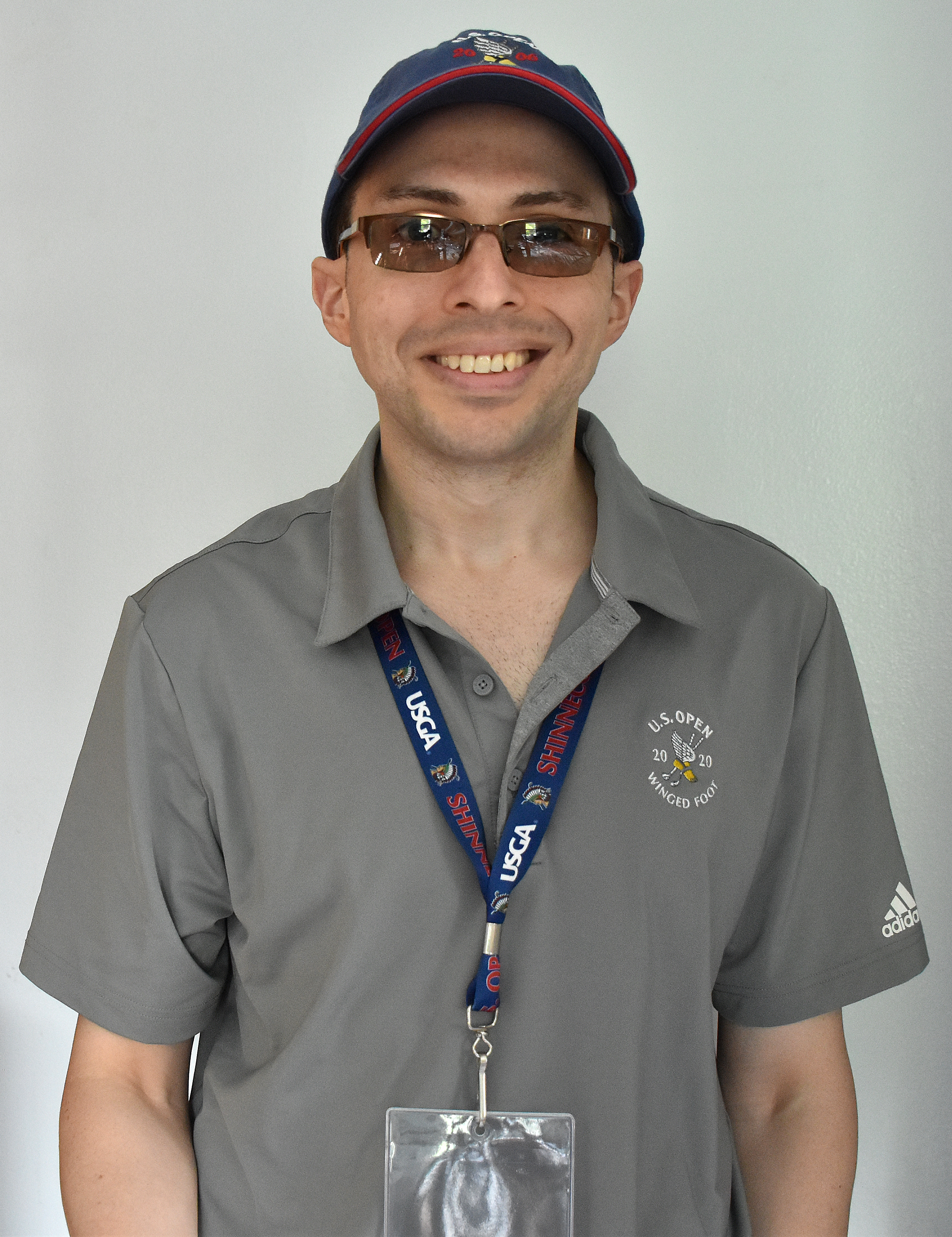
I connected my Nikon D5500 to a tripod, attached a remote, and photographed myself in front of a blank spot on my bedroom wall, clad in what I would have worn to the third round:

The hat is from 2006 and the ticket holder is from 2018.
Then, I applied an effect to make it seem like I was outside in the sun:
The third step was to combine the image with a shot of Winged Foot I found on Google:

I used the magic wand tool to highlight the wall so I could delete it, leaving only myself. Then, I copied and pasted what was left over the Winged Foot image. After initially placing myself in the center of the image, I cropped it down and re-centered myself. This is the end result:
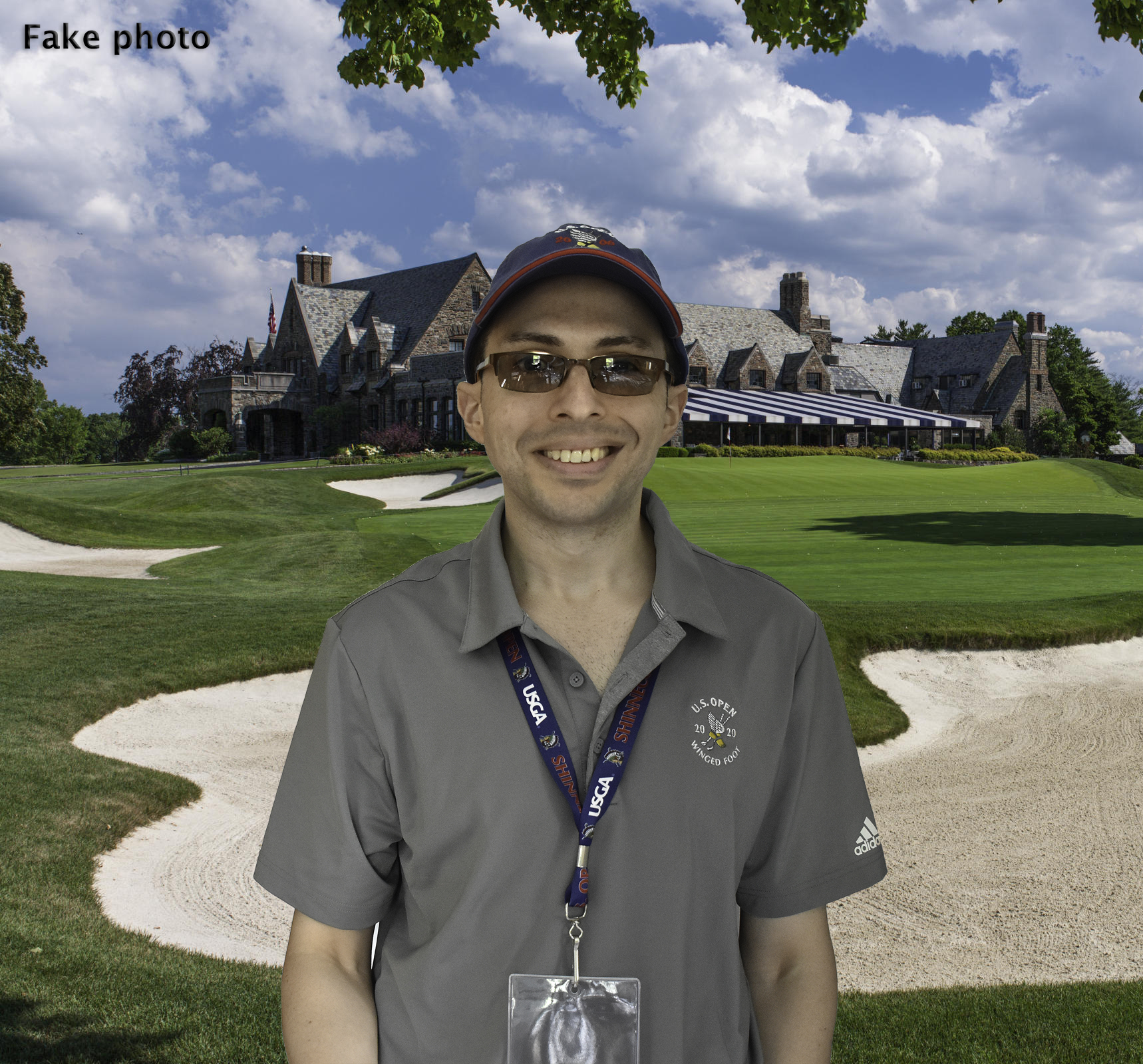
For publicity’s sake, I made sure to note it was a “fake photo.” I posted to Facebook upon completion on the 10th and to Instagram on the morning of the 19th.
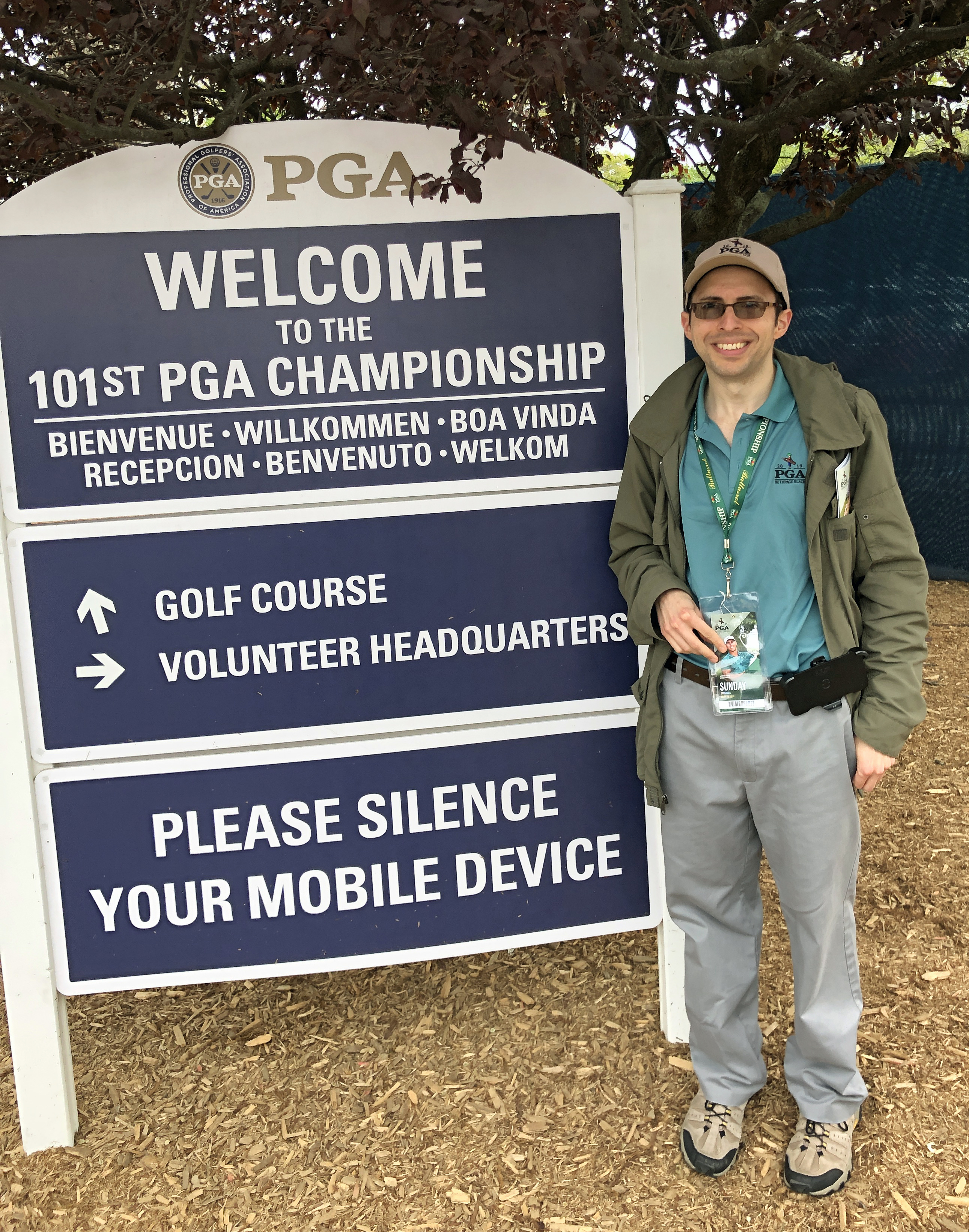
Fall conditions were in effect in the area, which meant I’d have a jacket on if I was truly in person, as I did last year at the PGA:
I watched all four rounds of the U.S. Open on TV like everyone else, but not on FS1 and Fox. The rescheduling put Fox in a bind as they were committed to college football on Saturday and the NFL on Sunday. The only solution was to relinquish their USGA rights back to NBC Sports, which they did on June 29. Starting this year, Thursdays and Fridays would be seen on Golf Channel with weekend coverage on NBC. This also meant the previous U.S. Open theme, “In Celebration of Man” by Yanni (pardon the audio quality), made its return. (A bagpipe-infused version was made for Open Championship coverage, as heard in 2016.)
At the end of 72 holes, Bryson DeChambeau was the 120th United States Open champion. He was the only player to shoot under par in the final round and the only player under par for the championship. Bryson joined Jack Nicklaus and Tiger Woods among players to win an NCAA individual title, the U.S. Amateur, and the U.S. Open. It was his first career major victory and I was very glad for him.
The end result motivated me to include the polo shirt in my regular rotation, just as I do with shirts for most of the other tournaments I’ve attended.
The next major to be held in the New York metropolitan area comes in May 2022 when the PGA Championship is held at Trump National Golf Club Bedminster in New Jersey. I hope the world is post-pandemic by then so I can be there in person. (Other future sites can be found here.)
1/11/21 UPDATE: The 2022 PGA has been pulled from Trump National Bedminster due to the riot at the U.S. Capitol last Wednesday by some of the outgoing president’s supporters. An alternate venue has not been chosen yet. I hope it’s one in the New York metro area as Bedminster would have been.
2/4/21 UPDATE: The PGA announced their replacement last week, which I didn’t find out until this morning. It’s far removed from the New York metro area: Southern Hills Country Club in Tulsa, Oklahoma. They were originally scheduled to host the PGA in 2030, which means a new venue will have to be picked for then. The next major in the New York metro area will be the 2026 U.S. Open at Shinnecock Hills.
I’ll leave you with video and additional articles related to the final round of the 120th U.S. Open.
VIDEO:
John Pak finishes as low amateur
Final round top shots
Final round extended highlights
Bryson DeChambeau, every televised shot
2020 U.S. Open top shots
Every televised shot from DeChambeau’s victory (all rounds)
Trophy presentation
Press conference
Bryson with Todd Lewis on Live from the U.S. Open
Bryson with Todd Lewis on Morning Drive
ARTICLES:
Will Gray, Golf Channel: Bryson DeChambeau cruises to U.S. Open win for first major title
Michael Bamberger, Golf.com: Victory & Validation: Bryson DeChambeau won the U.S. Open on his own terms
Mike Dougherty, Rockland/Westchester Journal News: Bryson DeChambeau vindicated after dominant finish at Winged Foot
Bill Pennington, The New York Times: Bryson DeChambeau wins U.S. Open his way: in commanding fashion
Mark Cannizaro, New York Post: Bryson DeChambeau runs away with U.S. Open for first major title
Greg Logan, Newsday: Bryson DeChambeau powers his way to his first major at Winged Foot
Instrumental Invasion, 9/16/20 September 17, 2020
Posted by Mike C. in Airchecks, Audio, Comedy, Film, Internet, Jazz, Media, Music, Personal, Radio, TV, Video, Video Games.add a comment

The September 16, 2020, Instrumental Invasion on WCWP is the 25th show overall. It was recorded over two days: the first hour on August 21 and the second on the 22nd.
The playlist was created on August 18 and annotated on the 19th, with additional annotations during each recording session.
I finished recording in the nick of time. After the last talk break, the landscaping crew for the two houses directly behind my bedroom began running their leaf blowers.
I had to work in “Working Girl March” by Dave Grusin from the Tootsie soundtrack, which I bought immediately after watching the film on Netflix a week before recording. The version on the soundtrack is not the cue used in the film.
The show intro was one of three talk breaks I scripted out in Notepad. Each had a lot of information to share and I didn’t want to get stuck.
The ends of the talk-ups for “Cruisin'” by Larry Carlton and “Hacienda” by the Jeff Lorber Fusion had to be remixed and precisely spliced over the original mixes. The first talk-up had a glitch between “not” and “Grusin.” The second required me to raise the gain on “this time” because it was too low to hear as I raised the music levels.
I didn’t mention it on the air, but the notes at the end of Larry’s solo on “Cruisin'” always remind me of the pause sound in Konami games for the NES:
Now, here’s the pause sound mixed with the end of the solo:
I noted that Jean-Luc Ponty performed “Tender Memories” on David Sanborn‘s Night Music around the time Storytelling was released. Here is that performance:
Click here to download the show 25 aircheck MP3 or listen below:
Joe Falco documentary audio used in podcast September 11, 2020
Posted by Mike C. in Audio, Fire, History, Interviews, News, Podcast.add a comment
On August 10, Scott Johnson contacted me requesting permission to the audio from the Joe Falco documentary that served as my college senior project. I graciously granted Scott permission to use it in an episode of his podcast, What Was That Like. The episode went up today, on September 11. Joe’s portion begins at around 18:05.
Here are relevant portions of the episode’s page:
Joe Falco was a New York City firefighter. He was working to save lives at the World Trade Center, and was injured when the buildings collapsed.
…
Thanks to Mike Chimeri for his permission to use the Joe Falco audio. Mike’s father, Bill, currently works as a volunteer with Joe Falco at the Freeport Fire Department Truck Company. Mike is the host of an instrumental music radio show on public radio station WCWP. You can check out his work at his website, MikeChimeri.com.
Thank you very much, Scott, for including the project in your podcast.
POSTSCRIPT: The project was created in fall 2003. Two years earlier, I wrote about my 9/11 experience in a portfolio summary for a broadcasting course. I posted that to my blog, along with an original follow-up, on the tenth anniversary.
Instrumental Invasion, 9/9/20 September 10, 2020
Posted by Mike C. in Airchecks, Audio, History, Internet, Jazz, Media, Music, News, Personal, Podcast, Radio, Video.add a comment

The September 9, 2020, Instrumental Invasion on WCWP was recorded over two days: the first hour on August 14 and the second on the 15th.
The playlist was created on August 11 and annotated on the 12th, with additional annotations during each recording session.
Even though they only air once, I like to keep my shows evergreen, but I was aware this show would be airing two days before September 11. So, I referenced Philippe Petit, who in 1974, walked on a wire between the roofs of the World Trade Center towers. I played “The Firehouse Chill” by Fourplay, then acknowledged my father Bill, a volunteer firefighter for the Freeport Fire Department‘s Truck Co. 1.
I’ll mention here that my dad’s friend Joe Falco is also a member Truck Co., as well as Engine 1/Ladder 24 in the FDNY. It was in that capacity on 9/11 where he survived the collapse of the World Trade Center’s south tower (2 World Trade Center). My dad interviewed Joe, affectionately known as Bubba, for a documentary that served as my college senior project. I posted that documentary to my YouTube channel in 2016:
9/11 UPDATE: The audio from the video was included, with my permission, in the latest episode of a podcast called What Was That Like.
As for the September 9 radio show, click here to download the aircheck MP3 or listen below:
 MikeChimeri.com