Attending the 2020 U.S. Open in spirit; how I got through the COVID-19 lockdown September 22, 2020
Posted by Mike C. in Comedy, Dogs, Golf, Health, Internet, Media, Music, New Age, News, Personal, Photography, Sports, Tennis, Travel, TV, Video, Video Games.add a comment
2020 would have been the third year in a row I attended a PGA Tour major championship held in the New York metropolitan area and fourth year in the last five. In 2016, I traveled to Baltusrol Golf Club for the second round of the PGA Championship. In 2018, I was briefly at Shinnecock Hills for the third round of the U.S. Open. And last year, I witnessed the final round of the PGA at Bethpage Black Golf Course, the third time a major had been held there.
This year, the U.S. Open was to return to New York in June, as usual, to be held at Winged Foot Golf Club in Mamaroneck. As my dad and I had done in 2002 and 2018, we opted to attend the third round so that he could watch at home on Father’s Day. We attended the final round the last time the championship was at Winged Foot in 2006. We were on the periphery of Phil Mickelson‘s collapse on the final hole. So many people stood by the 18th green that we could only hear the undoing. It was a depressing walk to the bus terminal and ride back to general parking at Orchard Beach in the Bronx.
Shortly after Dad bought the 2020 third round tickets in December, I bought a polo shirt that I would proudly don as I walked Winged Foot’s West Course. I had visions of aerial shots of the course along and ground level views of flags flying in the breeze while Brian Tyler‘s epic theme for Fox Sports‘ USGA coverage – “Triumph of the Spirit” – danced through my head.
Meanwhile, an insidious disease was spreading its way around the world. By March, Coronavirus Disease 2019 – also known as COVID-19 and the coronavirus – had reached the United States. State and local governments put residents on lockdown. Events were canceled or postponed left and right. Sports were put on hold indefinitely.
It was a sudden, sharp, and scary change that was very hard for me to bear. I was so scared and paranoid that I avoided watching or reading the news. It was torture passing by the den as my parents watched New York Governor Andrew Cuomo’s daily briefings. His voice was the last thing I wanted to hear as it served as a harsh reality check. Social media wasn’t any better. Every day, another public figure became a casualty. Some of my friends lost their friends. My dad lost two of his friends.
From March to June, I kept busy at home. I retouched photo scans, removing dust and scratches, and adjusting contrast and color. While I worked, I listened to music or to interview podcasts that didn’t reference the news. Once I landed a weekly radio show at WCWP, recording and producing the shows became another preoccupation. In my downtime, I watched videos on the various YouTube channels I subscribe to, learning about technology and video games. I also watched traditional TV programming: sitcoms like Last Man Standing and Man with a Plan, and the documentary miniseries The Last Dance, about the Chicago Bulls championship dynasty in the 1990s. I worked out religiously and watched what I ate. I bought groceries and other necessities online.
On social media, I limited my Facebook posts to treadmill running milestones, post-radio show blog posts, and photos from the past on Throwback Thursday (#TBT), Flashback Friday (#FBF) or #MemoryMonday. Instagram had some of those photos from the past, but I also began the Cocoa Photo Series, with new entries posted every two to three days. It’s photos of my late Chocolate Labrador from his puppy days in 1998 through Christmas 2006. Here’s an example.
As states and localities were phased back to somewhat normal, I left my house more often, disposable mask in hand when walking through the neighborhood and covering my face when necessary, especially when shopping. I still buy some things online, though.
For a few months now, I’ve begun to follow various dog accounts on Instagram, mostly for Labrador Retrievers. Watching dogs grow up is just what I need in these difficult times.
This concludes the COVID-19 portion of the post.
In April, I learned that three of the four PGA Tour majors were rescheduled for later in the year, with the [British] Open Championship being canceled outright. The U.S. Open was rescheduled for September 17 to 20, the first time the event was in September since 1913. (This meant it would occur a week after the conclusion of the tennis US Open, sans periods, held south of Winged Foot within the USTA Billie Jean King National Tennis Center. For the record, Naomi Osaka won the women’s singles title for the second time in three years while Dominic Thiem won for the men, his first grand slam title.)
Assuming spectators would be allowed, I would be attending the third round of the U.S. Open on September 19. I put the date in my iPhone calendar and hoped that fans got the okay to attend. On July 29, access was denied. I felt like I had wasted my money on a shirt for an event I couldn’t even see in person. At least Dad got refunded for the tickets.
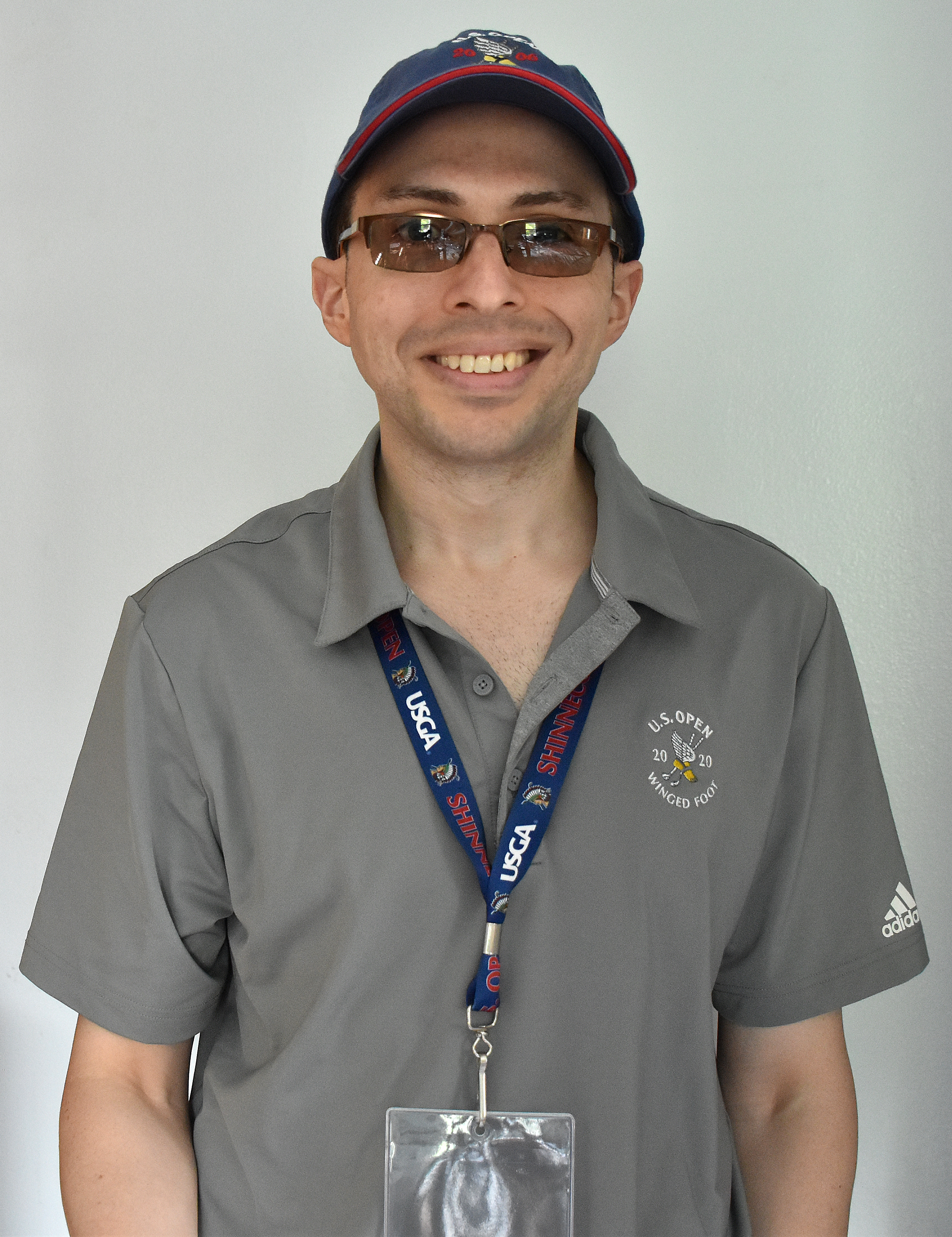
Indeed, to date, I’ve only worn it once since this Instagram post. That one time was on September 10, a week before the first round. It was for a photo project that would put myself at Winged Foot in spirit.
I connected my Nikon D5500 to a tripod, attached a remote, and photographed myself in front of a blank spot on my bedroom wall, clad in what I would have worn to the third round:

The hat is from 2006 and the ticket holder is from 2018.
Then, I applied an effect to make it seem like I was outside in the sun:
The third step was to combine the image with a shot of Winged Foot I found on Google:

I used the magic wand tool to highlight the wall so I could delete it, leaving only myself. Then, I copied and pasted what was left over the Winged Foot image. After initially placing myself in the center of the image, I cropped it down and re-centered myself. This is the end result:

For publicity’s sake, I made sure to note it was a “fake photo.” I posted to Facebook upon completion on the 10th and to Instagram on the morning of the 19th.
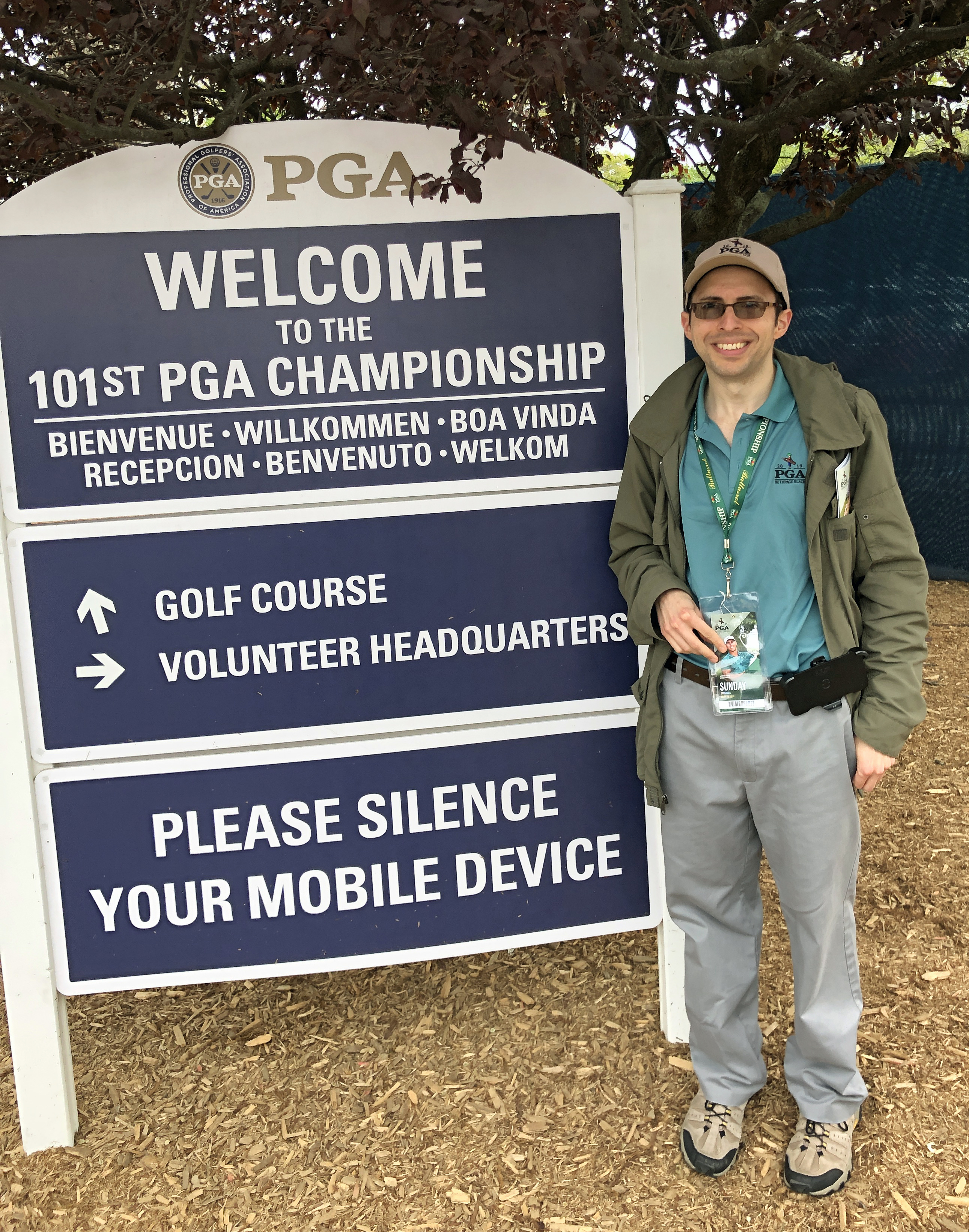
Fall conditions were in effect in the area, which meant I’d have a jacket on if I was truly in person, as I did last year at the PGA:
I watched all four rounds of the U.S. Open on TV like everyone else, but not on FS1 and Fox. The rescheduling put Fox in a bind as they were committed to college football on Saturday and the NFL on Sunday. The only solution was to relinquish their USGA rights back to NBC Sports, which they did on June 29. Starting this year, Thursdays and Fridays would be seen on Golf Channel with weekend coverage on NBC. This also meant the previous U.S. Open theme, “In Celebration of Man” by Yanni (pardon the audio quality), made its return. (A bagpipe-infused version was made for Open Championship coverage, as heard in 2016.)
At the end of 72 holes, Bryson DeChambeau was the 120th United States Open champion. He was the only player to shoot under par in the final round and the only player under par for the championship. Bryson joined Jack Nicklaus and Tiger Woods among players to win an NCAA individual title, the U.S. Amateur, and the U.S. Open. It was his first career major victory and I was very glad for him.
The end result motivated me to include the polo shirt in my regular rotation, just as I do with shirts for most of the other tournaments I’ve attended.
The next major to be held in the New York metropolitan area comes in May 2022 when the PGA Championship is held at Trump National Golf Club Bedminster in New Jersey. I hope the world is post-pandemic by then so I can be there in person. (Other future sites can be found here.)
1/11/21 UPDATE: The 2022 PGA has been pulled from Trump National Bedminster due to the riot at the U.S. Capitol last Wednesday by some of the outgoing president’s supporters. An alternate venue has not been chosen yet. I hope it’s one in the New York metro area as Bedminster would have been.
2/4/21 UPDATE: The PGA announced their replacement last week, which I didn’t find out until this morning. It’s far removed from the New York metro area: Southern Hills Country Club in Tulsa, Oklahoma. They were originally scheduled to host the PGA in 2030, which means a new venue will have to be picked for then. The next major in the New York metro area will be the 2026 U.S. Open at Shinnecock Hills.
I’ll leave you with video and additional articles related to the final round of the 120th U.S. Open.
VIDEO:
John Pak finishes as low amateur
Final round top shots
Final round extended highlights
Bryson DeChambeau, every televised shot
2020 U.S. Open top shots
Every televised shot from DeChambeau’s victory (all rounds)
Trophy presentation
Press conference
Bryson with Todd Lewis on Live from the U.S. Open
Bryson with Todd Lewis on Morning Drive
ARTICLES:
Will Gray, Golf Channel: Bryson DeChambeau cruises to U.S. Open win for first major title
Michael Bamberger, Golf.com: Victory & Validation: Bryson DeChambeau won the U.S. Open on his own terms
Mike Dougherty, Rockland/Westchester Journal News: Bryson DeChambeau vindicated after dominant finish at Winged Foot
Bill Pennington, The New York Times: Bryson DeChambeau wins U.S. Open his way: in commanding fashion
Mark Cannizaro, New York Post: Bryson DeChambeau runs away with U.S. Open for first major title
Greg Logan, Newsday: Bryson DeChambeau powers his way to his first major at Winged Foot
Instrumental Invasion, 9/16/20 September 17, 2020
Posted by Mike C. in Airchecks, Audio, Comedy, Film, Internet, Jazz, Media, Music, Personal, Radio, TV, Video, Video Games.add a comment

The September 16, 2020, Instrumental Invasion on WCWP is the 25th show overall. It was recorded over two days: the first hour on August 21 and the second on the 22nd.
The playlist was created on August 18 and annotated on the 19th, with additional annotations during each recording session.
I finished recording in the nick of time. After the last talk break, the landscaping crew for the two houses directly behind my bedroom began running their leaf blowers.
I had to work in “Working Girl March” by Dave Grusin from the Tootsie soundtrack, which I bought immediately after watching the film on Netflix a week before recording. The version on the soundtrack is not the cue used in the film.
The show intro was one of three talk breaks I scripted out in Notepad. Each had a lot of information to share and I didn’t want to get stuck.
The ends of the talk-ups for “Cruisin'” by Larry Carlton and “Hacienda” by the Jeff Lorber Fusion had to be remixed and precisely spliced over the original mixes. The first talk-up had a glitch between “not” and “Grusin.” The second required me to raise the gain on “this time” because it was too low to hear as I raised the music levels.
I didn’t mention it on the air, but the notes at the end of Larry’s solo on “Cruisin'” always remind me of the pause sound in Konami games for the NES:
Now, here’s the pause sound mixed with the end of the solo:
I noted that Jean-Luc Ponty performed “Tender Memories” on David Sanborn‘s Night Music around the time Storytelling was released. Here is that performance:
Click here to download the show 25 aircheck MP3 or listen below:
Instrumental Invasion, 9/9/20 September 10, 2020
Posted by Mike C. in Airchecks, Audio, History, Internet, Jazz, Media, Music, News, Personal, Podcast, Radio, Video.add a comment

The September 9, 2020, Instrumental Invasion on WCWP was recorded over two days: the first hour on August 14 and the second on the 15th.
The playlist was created on August 11 and annotated on the 12th, with additional annotations during each recording session.
Even though they only air once, I like to keep my shows evergreen, but I was aware this show would be airing two days before September 11. So, I referenced Philippe Petit, who in 1974, walked on a wire between the roofs of the World Trade Center towers. I played “The Firehouse Chill” by Fourplay, then acknowledged my father Bill, a volunteer firefighter for the Freeport Fire Department‘s Truck Co. 1.
I’ll mention here that my dad’s friend Joe Falco is also a member Truck Co., as well as Engine 1/Ladder 24 in the FDNY. It was in that capacity on 9/11 where he survived the collapse of the World Trade Center’s south tower (2 World Trade Center). My dad interviewed Joe, affectionately known as Bubba, for a documentary that served as my college senior project. I posted that documentary to my YouTube channel in 2016:
9/11 UPDATE: The audio from the video was included, with my permission, in the latest episode of a podcast called What Was That Like.
As for the September 9 radio show, click here to download the aircheck MP3 or listen below:
Instrumental Invasion, 9/2/20 September 3, 2020
Posted by Mike C. in Airchecks, Audio, Comedy, Film, Internet, Jazz, Media, Music, Personal, Radio, Video.add a comment

The September 2, 2020, Instrumental Invasion on WCWP was recorded two segments per day from August 5 to 7.
The playlist was created and annotated on August 4 with additional annotations during the recording sessions.
I had It’s a Mad, Mad, Mad, Mad World on my mind as I played Gerald Albright‘s cover of “It’s a Man’s Man’s Man’s World” by James Brown. I had seen the film on Amazon Prime Video earlier in the week. I didn’t like it as much I thought I would. I was hoping for a happier ending. I eventually came to accept the way the film ended and appreciate the its historical significance.
The horn section in Bob James‘s interpretation of “We’re All Alone” by Boz Scaggs was too numerous to mention in my back-sell, but you can read the list here.
Click here to download the aircheck MP3 or listen below:
Instrumental Invasion, 8/26/20 August 27, 2020
Posted by Mike C. in Airchecks, Audio, Internet, Jazz, Media, Music, Personal, Radio, Technology, Travel, Video, Video Games.add a comment

The August 26, 2020, Instrumental Invasion on WCWP was recorded on July 31.
The playlist was created on July 29 with annotations on the 30th and during the recording session on the 31st.
I was able to include “Bright Sky” by the Jeff Lorber Fusion after replacing it during the recording session for last week’s show.
As noted during the show, “Morning Dew” by Anders Enger Jensen is the theme song for videos by The 8-Bit Guy, who I was fortunate to meet at the Long Island Retro Gaming Expo in 2017 and 2018, attending his panel at the latter. (I also watched his panel at UPLINK earlier this month.)
Click here to download the aircheck MP3 or listen below:
POSTSCRIPT: During the height of the pandemic, WCWP hosts were asked to record messages to include in PSAs (public service announcements). Here was my contribution, recorded May 1, which may or may not have been used:
8/28 UPDATE: Upon listening to the aircheck, I realized missed an opportunity to segue from Bob Mamet‘s Day Into Night to Nelson Rangell‘s Turning Night Into Day. Instead, I got hung up on the saxophone aspect of the show before the spot break and blindly referred to “the sunrise directive” in the talk-up after.
UPLINK by LI Retro recap August 21, 2020
Posted by Mike C. in Art, Film, History, Internet, Interviews, Media, Personal, Technology, Video, Video Games.Tags: bob neal, coury carlson, David Murray, dB Electronics, DF Retro, Digital Foundry, frank cifaldi, hardcore gaming 101, HD Retrovision, hg 101, Jason Lindsey, jeremy parish, John Hancock, John Linneman, John Riggs, Kelsey Lewin, kurt kalata, LI Retro, marc duddleson, Metal Jesus, Metal Jesus Rocks, mlig, my life in gaming, Nick Mueller, René Richard, retronauts, retrorgb, Ste Kulov, The 8-Bit Guy, The Immortal John Hancock, try, try4ce, UPLINK, vghf, video game history foundation, Voultar, Zach Henson
add a comment
Long Island Retro Gaming Expo recaps: 2017, 2018, 2019
Since the early days of the COVID-19 pandemic, events have been canceled or postponed. The 2020 Long Island Retro Gaming Expo was no exception. In its place, the team behind the expo announced UPLINK by LI Retro, a convention held entirely online. They also announced that tickets for the 2020 LI Retro will be honored in 2021.

UPLINK ran August 8 and 9, the weekend intended for the expo. In the days leading up to it, I consulted the schedule to determine which panels I would attend remotely. Seven caught my eye.
Saturday, August 8
As UPLINK began, the cable remained out at my house, stemming from an outage that began around 7PM Wednesday, two hours before my radio show was to air. That meant until service was restored, I had to take part via 4G on my iPhone 11.
I only noticed one vendor in the exhibitor hall selling games and none that I was interested in. So, there won’t be any pickups at the end of the post.
Discord chat servers were set up on the right side of the main event page and on all panel pages.
My plan was to take notes during each panel and also take screencaps for private use and, if granted permission, a public blog post. (Obviously, I was permitted or you wouldn’t be reading this.)
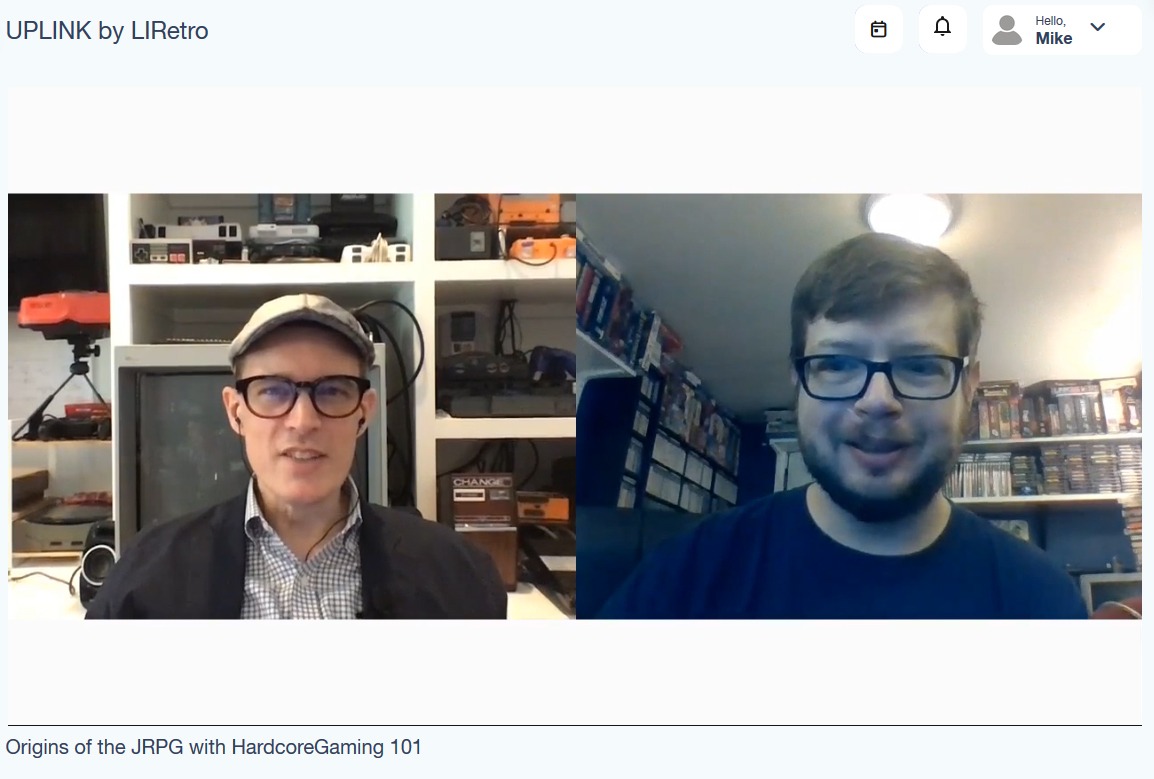
The first panel I attended, at 10:30 AM, was Origins of the JRPG (Japanese role-playing game) with Jeremy Parish, co-host of the Retronauts podcast and host of the Video Works series, and Kurt Kalata of Hardcore Gaming 101:


The games discussed were:
- Dragon Slayer
- Hydlide
- The Black Onyx
- Wizardry games in Japan
- Dragon Quest
- The Tower of Druaga
- Underground Exploration
- Spy Daisakusen
- The Dragon and Princess
- Khufu-ou no Himitsu (King Khufu’s Treasure)
- Danchizuma no Yuuwaku (Seduction of the Condominium Wife)
- Oranda Tsuma wa Denki Unagi no Yume Wo Miru ka? (Do Dutch Wives Dream of Electric Eels?)
- Megami Tensei
- Cruise Chaser Blassty
Some of the above games were chronicled in a 2013 HG101 post.
Jeremy and Kurt concluded by answering questions from the chat and Twitter, discussing Kurt’s upcoming JRPG book, and opining on the Trials of Mana remake.
I screencapped the panel from the archive video once my cable service was restored.
My next panel wasn’t until 1:45 PM, which gave me time to retouch photo scans on my computer while listening to an episode of Gilbert Gottfried’s Amazing Colossal Podcast.
The 1:45 panel was a My Life in Gaming Q&A with channel creators Coury Carlson & Marc “Try4ce” (“Try” for short) Duddleson:

Minutes into the panel, the 4G service fell to one or two bars, making UPLINK impossible to watch live. I hoped to watch the panel archives once cable was restored, whenever that would be.
Having given up, I turned on my TV to watch a film on Blu-ray. A strange thing greeted me: a message on the top right corner of the screen. Those only come if there’s a Wi-Fi connection. I walked into the guest room to check the cable modem. There were three solid lights! Not one solid and one blinking! The cable was back! My UPLINK weekend was back on!
Here are the notes I compiled while watching the archive:
- Coury had just finished mowing lawn. Try’s dog Sandy, a Shetland Sheepdog (Sheltie), sat with him.
- Games they bought last year at LI Retro
- Will they review the Analogue Pocket when it’s finally released next May?
- What games did they sell in their days before collecting?
- Game Boy mods (modifications)
- They compared the Sega Genesis core on the MiSTer to Analogue’s Mega Sg.
- Who are your Super Smash Bros. Ultimate mains? Try’s is Piranha Plant. He opted for Link and Luigi in the original Nintendo 64 game, Young Link and Dr. Mario in Melee on GameCube, and Pit from Kid Icarus in Brawl for the Wii.
- Coury and Try hope to do a video on OSSC Pro when that comes out. Try doesn’t think the Pro will be what everyone needs. The original is still amazing.
- They gave a nod to Bob Neal‘s weekly podcast: RetroRGB Weekly Roundup.
- PC monitors as an alternative to PVMs: different representation, valid alternative
- Thoughts on the Analogue Nt Mini Noir, due for release in November
- Archival content in Samurai Shodown NEOGEO Collection – Coury edited the Q&A videos
- Someone requested another Worlds of Power readthrough.
- Coury and Try talked about the Analog Frontiers series (part 1, part 2). Their dream schedule is part 3 in September, part 4 in November, and part 5 in January. They hope to do a Blu-ray release, as they did for Night Trap: 25 Years Later. (Full disclosure: My name is in the credits along with other Patreon supporters.)
- What games have they played during the pandemic?
- DCDigital is the best modding option for Sega Dreamcast
- Try’s editing techniques
- Will they ever sell their collections? Try said no. It’s hard to commit to game on flash carts like Krikzz’s EverDrive series.
- Zach Henson, a.k.a. Voultar, was in the chat. That led to quotes and impressions of him.
- They praised the Technology Connections YouTube channel, wondering what creator Alec Watson’s pool of ideas looks like. They said the videos are always such weird things.
- What are your predictions for retro gaming in 2030? Try would like to see a nearest neighbor 4K upscaler.
- What’s the best way to take still photos off a CRT? Coury said to use synchro scan on the Panasonic GH5.
- What’s your most proud video so far? Of the bigger videos, Try said Analog Frontiers, calling it his “magnum opus.” Among the smaller videos, the Tom duBois (“du-boyce”) documentary. It was shot in one day, from noon to 8PM. Coury is most proud of M2: Complete Works and Night Trap: 25 Years Later. He will be working on an Electronic Gaming Monthly documentary. The non-documentaries Coury is most proud of are the videos on first-party and third-party controllers. Try’s are RGB208, which focused on Nintendo’s portable consoles from Game Boy to Game Boy (Advance) Micro, and RGB210, all about the PlayStation 2.
The panel is available to watch on the My Life in Gaming YouTube channel:
I had a pair of primetime panels, but first, dinner and shows on my DVR that I missed while the cable was out.
At 7PM, there was a roundtable discussion moderated by Dom Delledera of the It’s All Fun and Games YouTube channel, with Metal Jesus Rocks & Friends: Metal Jesus, a.k.a. Jason Lindsey, The Immortal John Hancock, John Riggs, and Kelsey Lewin:

Due to technical problems, Riggs was a few minutes late.
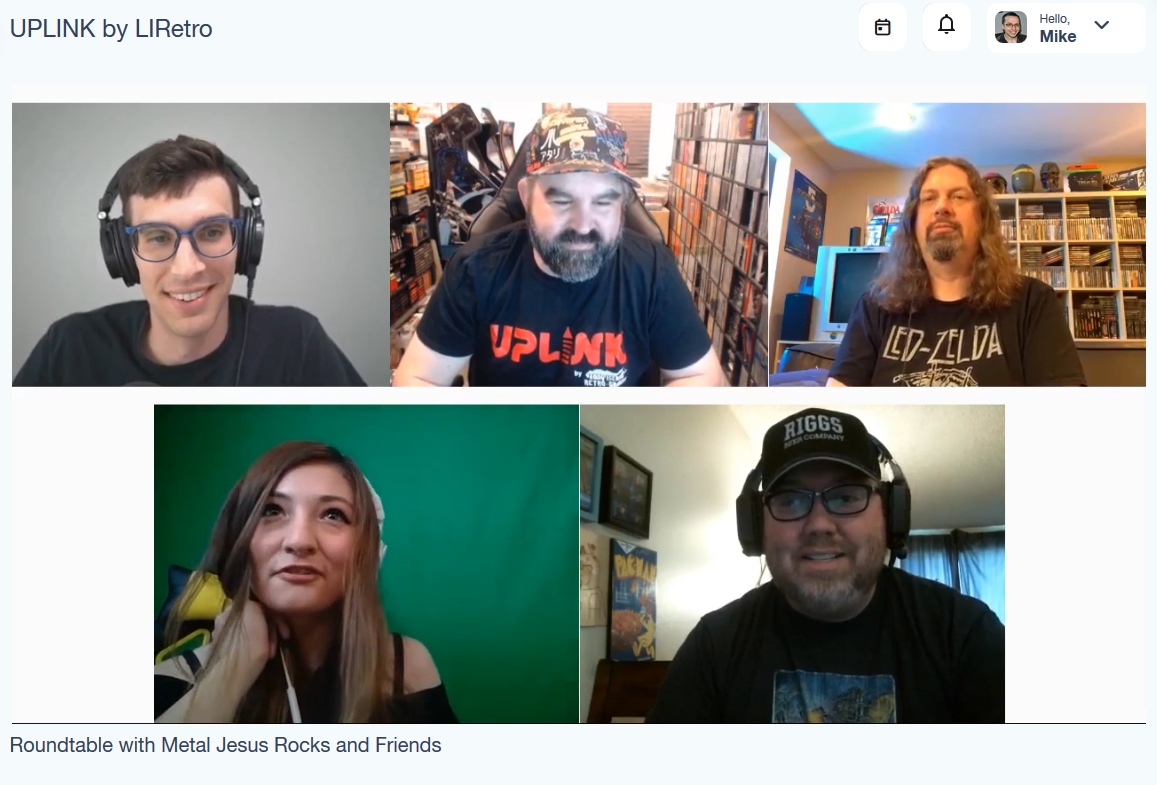
Dom is on the top left, John Hancock is top center, Jason is top right, Kelsey is on the bottom left, and John Riggs on the bottom right.
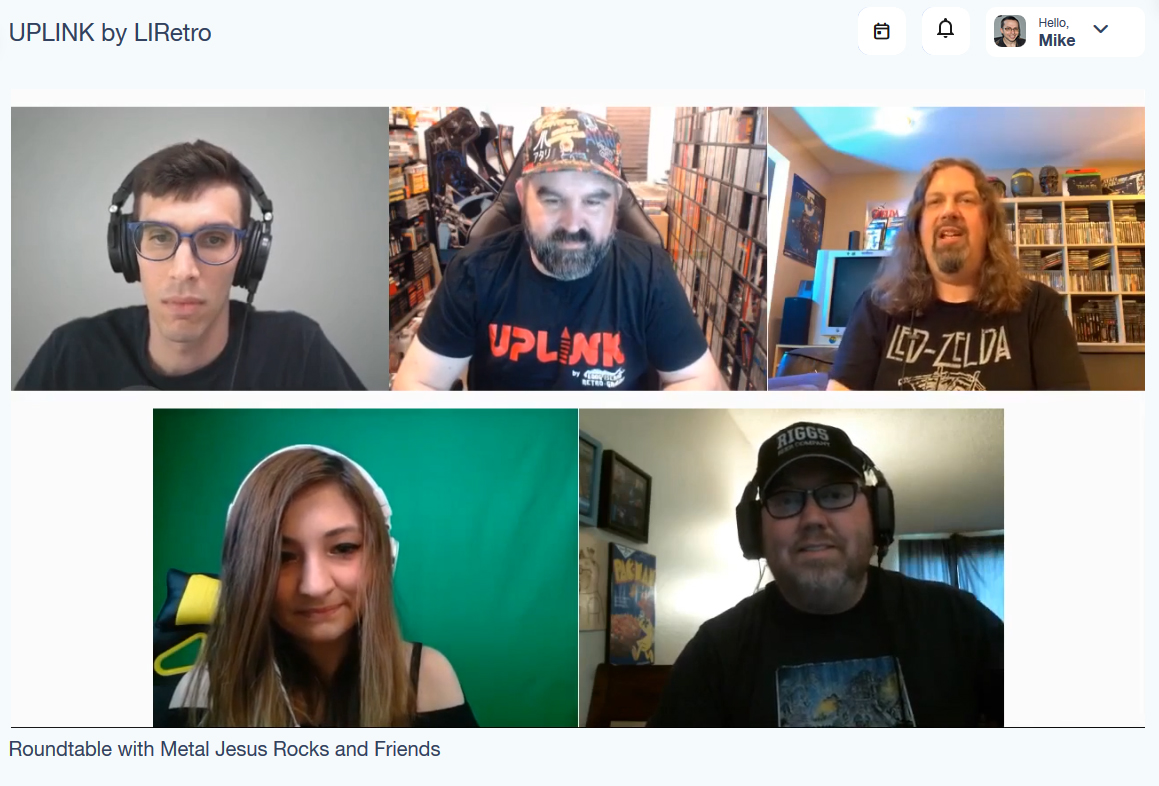

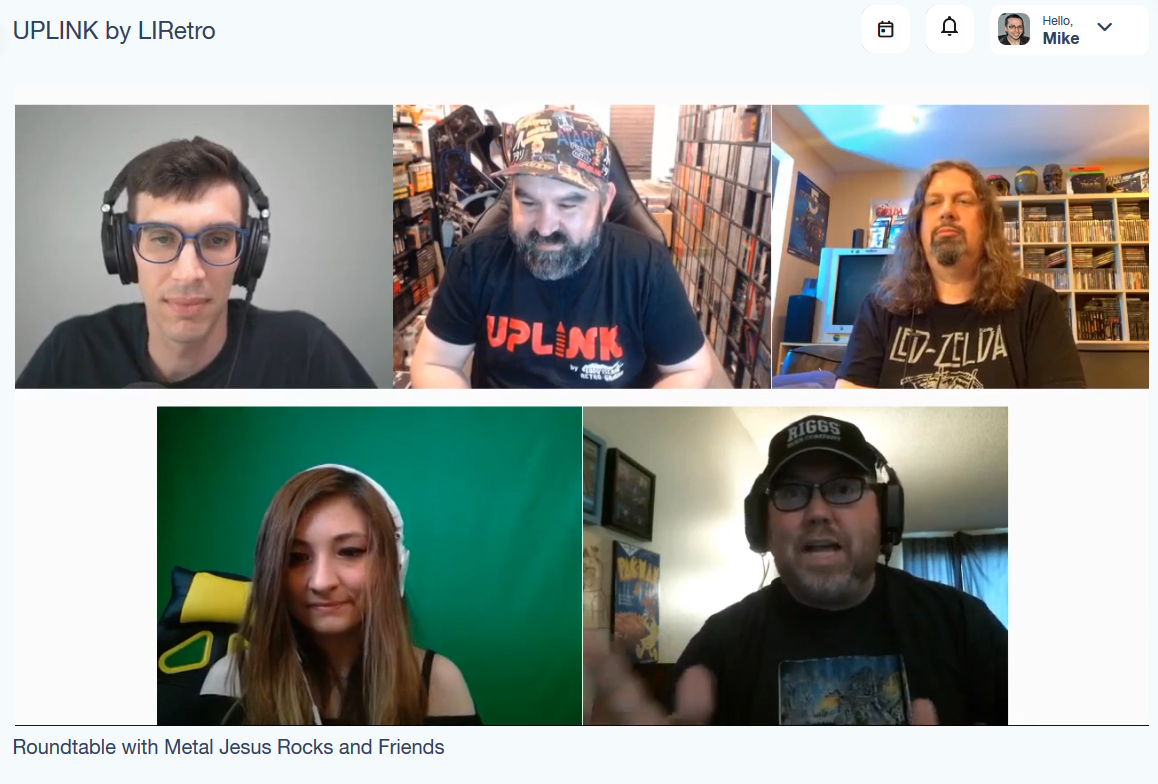
Metal Jesus and his friends are based in Washington State. Jason and Kelsey both live in the Seattle area, Riggs is in Yakima, and Hancock is based on Longview.
For this and subsequent panels in the recap, if a remark is not in quotation marks, it is not verbatim.
- How has everyone been during the pandemic?
- Kelsey noted how game prices were affected by the pandemic
- Games that Jason and Riggs have been looking for
- Jason has been buying PlayStation 3 games at various GameStop locations. He suggested collectors pick up games for PS3, Xbox 360, Wii, and Wii U.
- Hancock is currently collecting retro computer games and pursuing Nintendo Switch games.
- Riggs hasn’t been pursuing games due to the pandemic. His area is only at Phase 1. He’s fortunate to have an enormous backlog.
- Kelsey and Jason have started cataloging more often.
- Hancock went over his YouTube channel‘s recent videos, including The Many Ports of Joust, from Atari to Xbox.
- Riggs talked about recent videos on his channel.
- The conversation turned to preservation.
- Jason is a fan of really bad movies, such as Chopping Mall.
- All media has value, Jason said, whether it’s good or bad.
- Every game is someone’s favorite game, said Riggs.
- Hancock believes we need to consider obscurities.
- The current generation of games is difficult to preserve.
- Preserving mobile games: Jason preserved some of them on his iPhone 6
- Hancock lamented that we’re moving from an ownership model to a service model, and that’s concerning.
- Kelsey noted this has been a problem since the original Xbox.
- It’s not just archiving games, Jason explained, but also servers.
- Riggs bought NES games cheap during liquidation sales in the late 1990s. Examples: Bucky O’Hare for $4 and Contra Force for $6.
- Hancock used to get lots of games in a flea market with only $20 to $40 on him. He’s still finding deals at flea markets: a PS3 controller for $3, a Move controller for $5.
- Kelsey noted the economy of retro game collecting has changed so much in the last decade.
- Ever had to spend more than you wanted? For Jason, it was SSI gold box games and Neverwinter Nights. Kelsey spent more than she’d have wanted on Mama Mitte, a pregnancy tracker for the Bandai WonderSwan: $3,200. John Hancock’s big purchase was Magical Chase for the TurboGrafx-16: about $2,000 on a payment plan. John Riggs found The Flintstones: Surprise at Dinosaur Peak for NES (Nintendo Entertainment System) from Chile for only $200.
- The rarest game in Hancock’s collection that he never gets to talk about is the Microsoft BASIC programming cartridge for the Mattel Intellivision. Jason’s rarest game is a DS cartridge for horse race betting.
- Kelsey asked if anyone had anything rare outside of games. Jason has CDs that there’s only one copy of, such as a demo tape at a Nevermore signing by an album producer who also produced Queen. Hancock is an all-in guy; just games. Riggs has old cereal boxes. And Kelsey collected Nintendo toys from before they made video games.
- Hancock and Riggs listed the games that their children play. Riggs’s 12-year-old son, who is autistic (I’m also on the spectrum), loves Clubhouse Games for the Switch.
- What plans do they have for their collections at end of their lives? Hancock has a non-profit formed and is working on a museum. He never intended to keep his collection. Kelsey’s collection is committed to the Video Game History Foundation, where she is a co-director. (More on that in the VGHF panel later in this post.) Riggs has been piecing out his collection, selling some games at conventions.
- What have you given up looking for? John Hancock gave up Neo Geo AES carts, prototypes, signage, and kiosks. Jason’s through looking for arcade machines. For Kelsey, Bandai WonderSwan store displays and WonderSwan “booth babe” outfits. She does have an inflatable WonderSwan balloon. Riggs has given up on the Ultimate Journey NES prototype.
- Jason hoped he’d find more 64DD development disks, after previously finding a 64DD, but no one came forward.
- In closing, Dom asked if Jason had a hidden gem. He chose Skyrim VR. It’s not really a hidden gem, but it’s the first thing that came to mind.
Immediately after the MJR panel, I jumped to the Fireside Chat with David Murray, The 8-Bit Guy, moderated by George Portugal:

- The Tech from Texas series (part 2)
- New backyard workshop in backyard to be built over the next 3 to 4 months – will be able to work on projects more efficiently
- David keeps retro hardware in his attic. There’s little room for it elsewhere in the house.
- He won’t be moving his office into the workshop.
- The DFW (Dallas-Fort Worth) retro computer community – used to have regular quarterly meetings – everyone would bring something – active Facebook group
- David doesn’t ask for donations anymore because he can just borrow a given item from the community.
- The Commander X16 project is 99% complete. He hasn’t been involved much in current development. Everything is working on the board except for the video chip. If it were booting now, he would start the Kickstarter campaign. He needs a functioning prototype first. He expects the Kickstarter to launch in the fall. Some people could have an X16 by Christmas. Christian Simpson, a.k.a. Perifractic, is doing the manual.
- David talked about his various series on manufacturers – Commodore, Tandy, Sinclair – and took future episode suggestions.
- He reacted in agreement to my Discord chat post: “You can’t please everyone.”
- The worst videos to make are the ones that never got finished.
- David gave an update on the Commodore series DVD (or Blu-ray). He’s waiting to finish it with a video on the Amiga line. He doesn’t know much about it outside of the 500, and is communicating with experts for help.
- He will also need help in scripting the TRS-80 series video.
- Are there YouTube channels David enjoys or watches? There are two he subscribes to: LGR (Lazy Game Reviews), run by Clint Basinger, and Techmoan, run by Mat Taylor. He also watches Perifractic and electric car-related channels. He has heard of and talked to the Nostalgia Nerd. He’s seen Technology Connections videos, but hasn’t talked to Alec. He likely won’t meet Mat since he doesn’t travel or do conventions.
- David keeps a running list, in spreadsheet form, of topics he wants to cover.
- His favorite video is the history of the Commodore VIC-20, which was his first computer. He also likes the two-part VIC-20 restoration video (part 1, part 2), which each got over a million views.
- Are you PC or Mac? David is both, but edits on a Mac.
- He hardly has time for games unless it’s for the purpose of a video. When there is time, he’ll play StarCraft, Duke Nukem 3D, and his own game, Planet X3.
- Will there be a Planet X4? David says maybe. He’s working on something similar that’s closer to SimCity and M.U.L.E.. Whatever the next game is, he wants it to work on all Commodore systems. He’ll code it on the PET.
- David likes programming constraints.
- He might be getting a THEVIC20 mini console to review.
- He has no desire to port Planet X2 to Atari 8-bit computers.
- David owns all the equipment to do a video on Family BASIC for Famicom, which was donated to him recently. He’ll need help, though.
- His favorite Commodore 64 games are the Ultima series, Master of the Lamps, M.U.L.E., Ghostbusters, Action Biker, Spy vs. Spy, Maniac Mansion, and Zak McCracken and the Alien Mindbenders.
- David went on Richard Garriott‘s property for the Austin episode of Tech from Texas, speaking to Richard about that earlier in the year. Richard was in France at the time, and would have come back, but when the pandemic struck, he stayed in France. Instead, David was shown around the property by former Origin Systems employee Scott Jones and former Portalarium employee Edward Vitralis.
- David’s least favorite computer that he reviewed are the Advantech I.Q. Unlimited by V-Tech and the Timex Sinclair 1000. His least favorite that he restored was the Osborne (part 1, part 2, part 3).
- His favorite current computer storage medium is SD card; retro is 3.5″ floppy.
- Are UV lights the best approach to retrobriting vs. the sun? David still prefers to use the sun, if available because it’s much faster.
- David’s wife and daugther don’t help much with videos. His wife was camera operator in Austin, and his daughter handled that in Houston.
- He talked about his appearance in a recent Krazy Ken’s Tech Talk video. It was recorded last year, and he forgot he even said what he did in the video.
- David lamented that he couldn’t come to Long Island this year. He had a speech planned on the demo scene, which would have been revamped from a previous speech at Portland Retro Gaming Expo (PRGE), which was also canceled this year. He doesn’t like the IMAX theater in the Cradle of Aviation Museum. You can’t see the audience when the lights are dimmed. The projection on the IMAX screen is curved. Everyone is up above.
- Hopefully, in person next year.
That was the last of my Saturday panels. I finished watching a movie on Prime Video and went to sleep.
Sunday, August 9
My first panel of the day wasn’t until 12:15 PM. Of the three panels I planned on watching, two conflicted with each other. So, I opted to watch one live and the other later.
The 12:15 panel was the Retro Roundtable hosted by Bob Neal of RetroRGB (top left), with Ste Kulov (top center) and Nick Mueller (bottom center) of HD Retrovision, Zach Henson, a.k.a. Voultar (top right), and René Richard (bottom right) of dB Electronics:
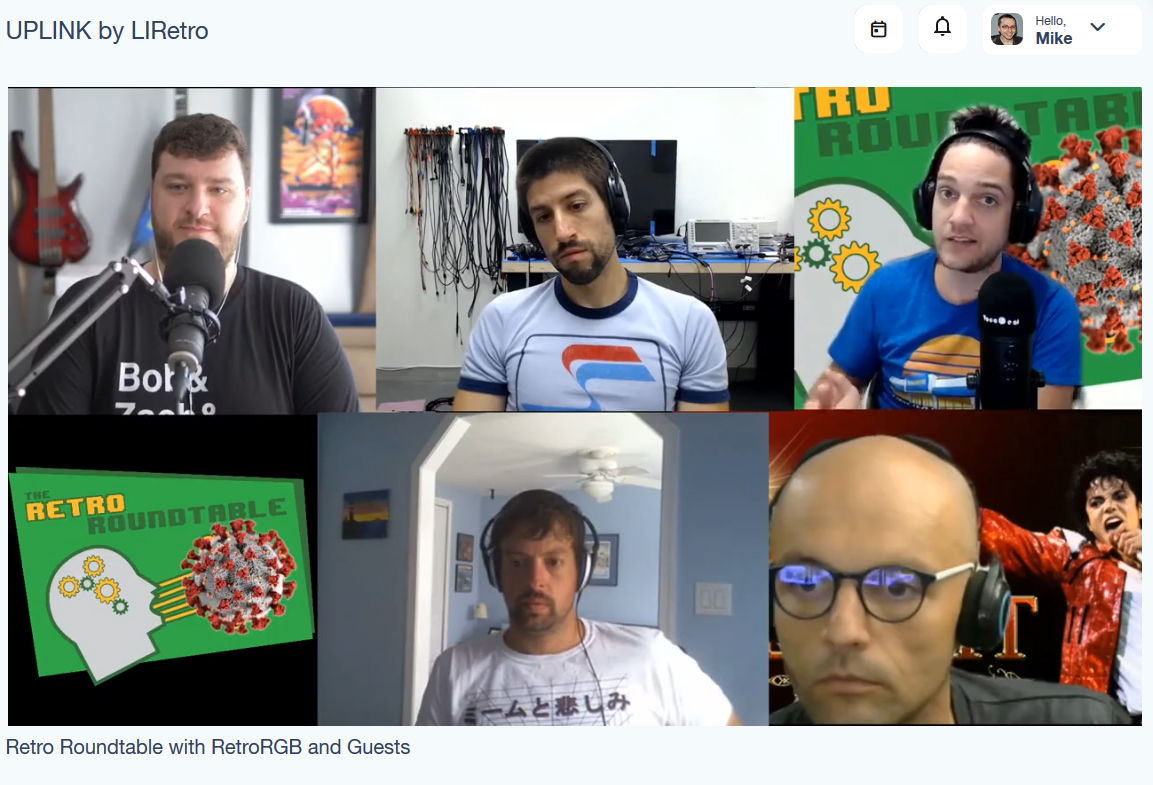
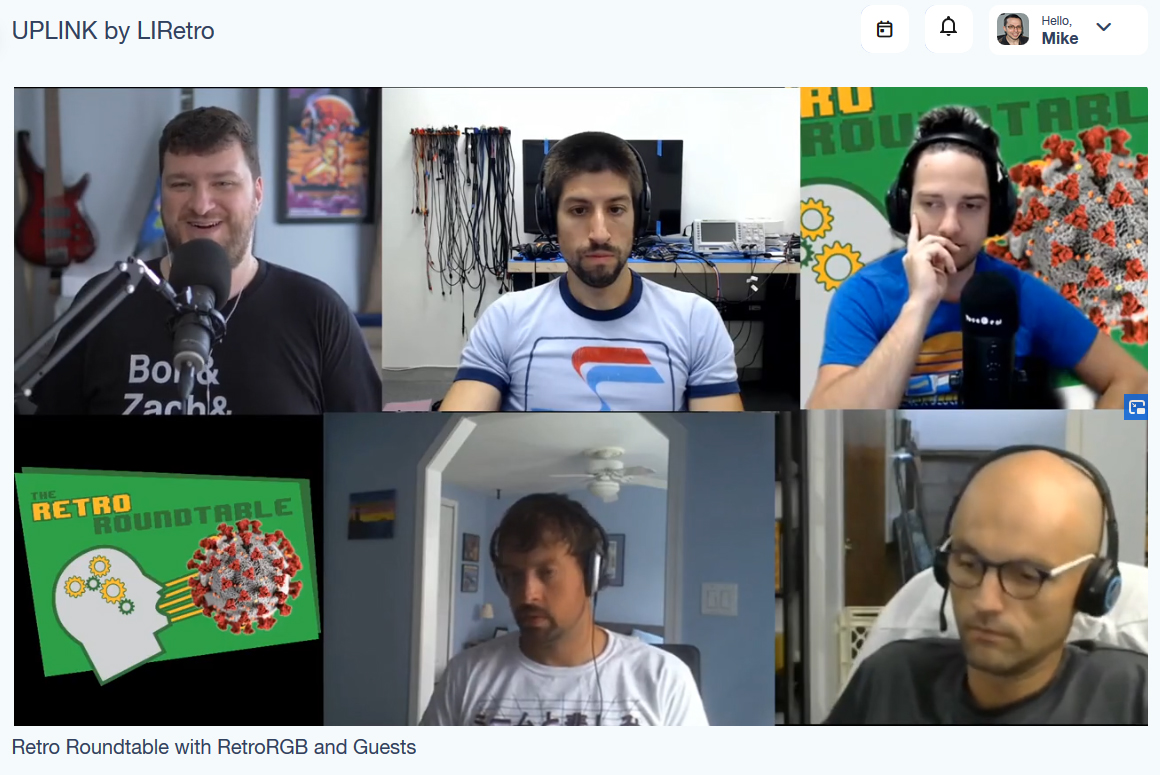
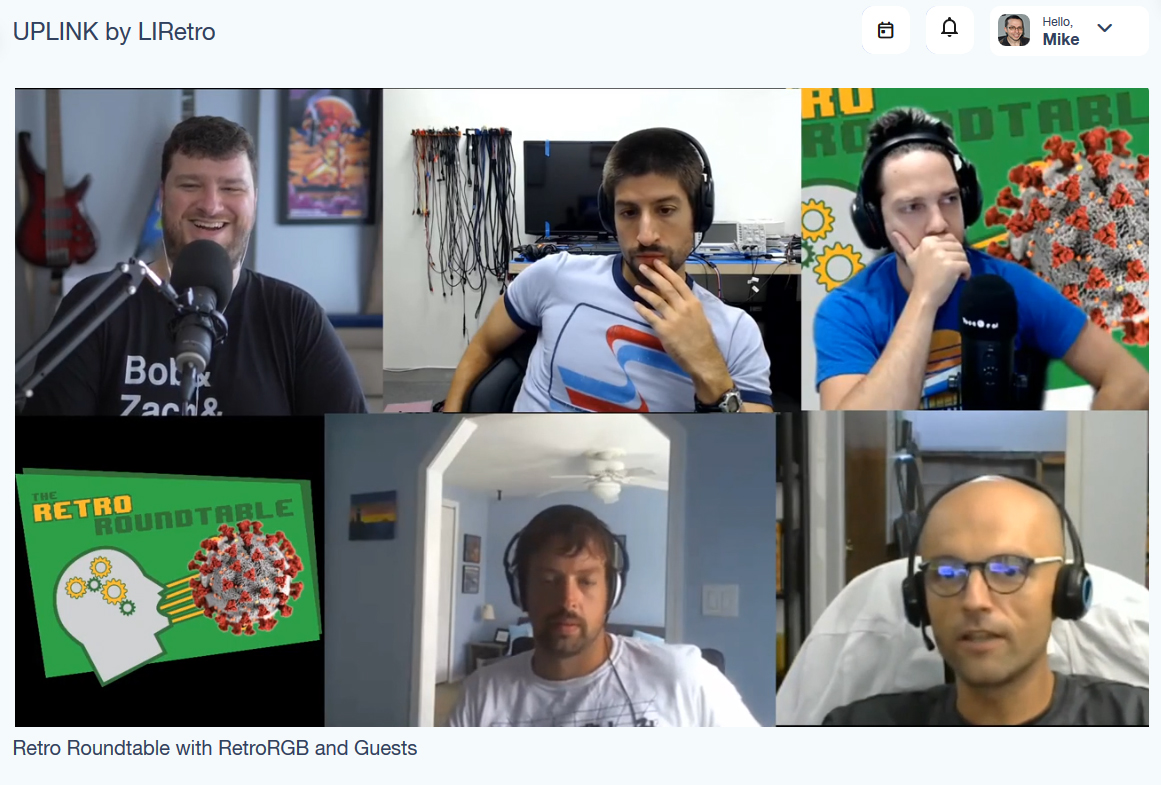


- René wore a mask initially.
- Bob was the only one to wear a t-shirt that says “Bob& Zach& René& Nick& Ste.”
- What everyone’s been up to?
- Bob, Ste, and Nick’s lives haven’t changed much. Zach’s has due to Kentucky small business regulations and government mandates. He had issues with the shipping system. At one point in the pandemic, items weren’t arriving on time, but “things are much better now.”
- René said there was one COVID case in his town. Schools were shut down, and he worked from home for two months. René was eventually allowed back to his office, but with a mask, and he had to wash his hands after entering and before exiting. He quit Twitter about a year ago. René’s house got flooded, and he had to tear out the drywall. He hadn’t worked in the last few months, nor had he played any games during the post-flood restoration. He started playing games again two weeks ago.
- Bob talked about the Sony BVM D32.
- The last game Bob beat was The Legend of Zelda: Link’s Awakening for Nintendo Switch. He has been using the PlayStation 2 version of OutRun 2006 to test other games. It’s a really fun racing game, he said.
- Ste learned how to machine aluminum, had a problem with a U.S.-based supplier – Nick clarified it was over Dreamcast cables – and he played Final Fantasy VII Remake.
- Nick said it took three months to ship cables to a distributor in Switzerland via USPS.
- Bob lamented his shipping woes.
- The last game Zach played was also Link’s Awakening. Like Bob, he can look beyond the subtle frame rate issues.
- Zach and Ste rented server space, at $9 a month, for games they love to play, such as Battlefield 2142. They soon hope to invite friends and viewers to play in the server. Ste noted it’s running now via OpenSpy. Zach said all Doom games are on the server.
- Bob asked if you can up the frame rate on older PC games. Zach said yes. A game’s vertical refresh rate will sync to the refresh rate of your monitor.
- There was talk of two PlayStation ODEs (optical disc emulators): CybDyn’s PSIO and the upcoming xStation by Robert Neumann. (Zach posted a video on the xStation the day before.) ODE loading speeds were compared to loading speeds on disc.
- They talked about the MiSTer FPGA (field-programmable gate array).
- René listed the flash carts he has.
- Krikzz’s Mega EverDrive PRO vs. Terraonion’s Mega SD, two carts that can play Sega CD games and Virtua Racing for Genesis
- The subject turned to personal non-retro projects: René built his own amplifier, which he showed off. It’s a 4-channel tube amp that he made back in about 2008. Unfortunately, there’s a pop sound when switching between high and low gain.
- The issue of repro (reproduction cart) sellers was debated.
- Zach promoted his cartridge patching and translation service.
- Bob joked about a “guitar-off.” René’s been practicing guitar, improving his skill for the first time since 2012.
- Bob went over his recording process.
- The panel talked about the Analogue Pocket. Zach said their marketing is “disingenuously brilliant.” They praised Kevin Horton, a.k.a. Kevtris, who worked on previous Analogue consoles.
- Zach plugged an upcoming video on Analogue.
- What are their thoughts on mini consoles? Bob thinks they’re best for a nostalgia fix; Zach said they’re a fun novelty.
- The panel universally praised 8BitDo products, then showed off controllers from 8BitDo, Krikzz, and Retro-Bit.
- Ste and Nick gave an update on HD Retrovision.
- There was a plug for the upcoming MLiG/John Linneman panel.
The Video Game History Foundation panel at 2PM was the one I chose not to watch live. I watched on Wednesday, taking the most comprehensive notes out of any panel I watched.
This panel was moderated by Jeremy Parish, co-host of the Retronauts podcast and host of the Video Works series, who I saw on Saturday morning in Origins of the JRPG. His guests where VGHF founder and co-director Frank Cifaldi and co-director Kelsey Lewin, who I saw in the Metal Jesus roundtable on Saturday night.

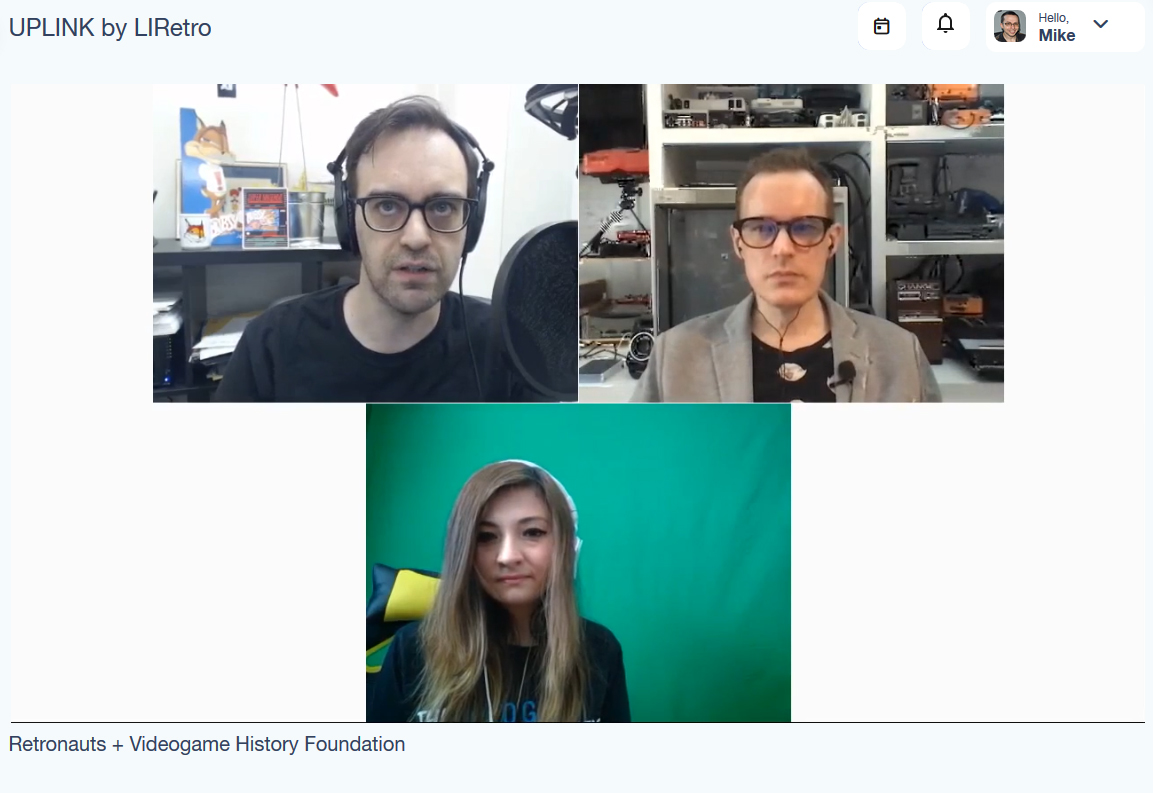
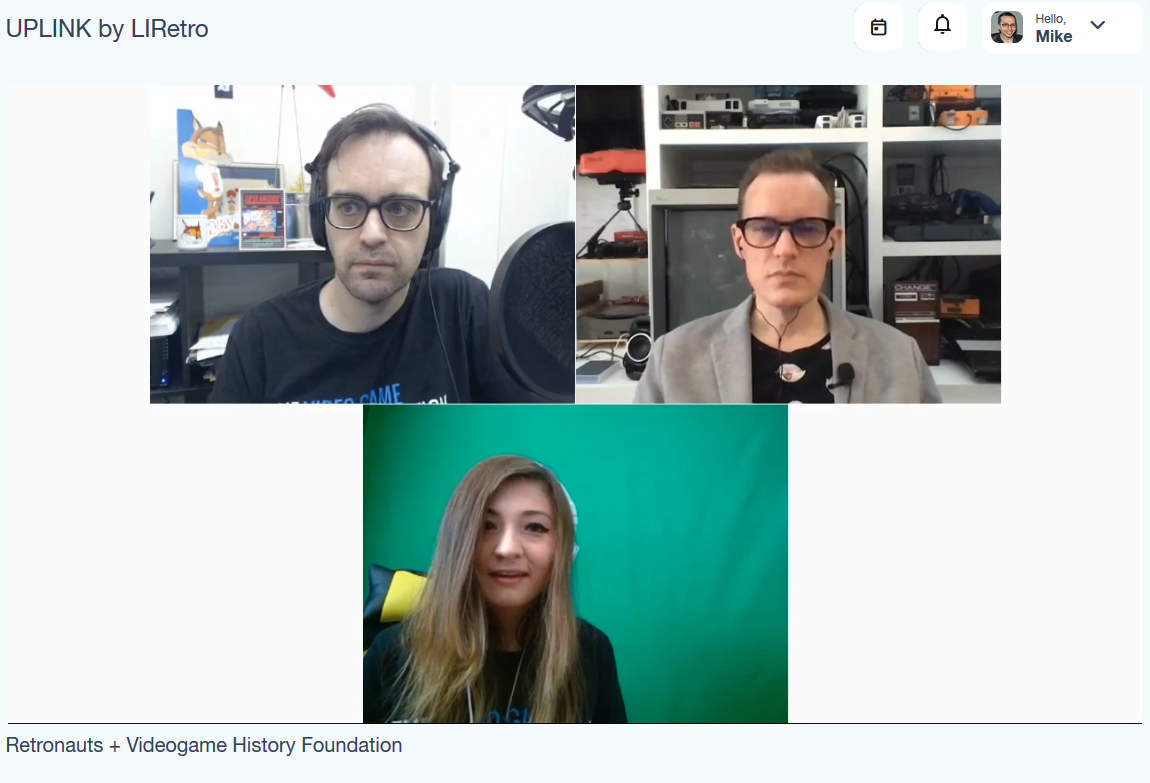
- Jeremy first thought of doing a VGHF update during last year’s Long Island Retro Gaming Expo. He would have had a panel at the GDC (Game Developers Conference) in the spring, but “the whole world got sick.” (The GDC was rescheduled to a few days before UPLINK was also held virtually.) Jeremy was “glad that we can finally make it happen” at UPLINK.
- Jeremy spoke to Frank, Steve Lin and Mike Mica about their starting VGHF three years ago during California Extreme.
- Frank got into video game history through the video game industry, starting in the late ’90s as a video game journalist. His first entry to preserving video games was seeking out cartridge-based console games that weren’t yet preserved digitally. He was inspired by The Film Foundation, applying that line of thinking to video games. He started a website called Lost Levels, the first to focus on unreleased games. He talked to game developers. He worked Gamasutra and 1UP. Frank is also in game development, working for Digital Eclipse on their game compilations. He was the producer/director of the Mega Man Legacy Collection and SNK 40th Anniversary Collection. He also worked on Street Fighter 30th Anniversary Collection and The Disney Afternoon Collection. The Video Game History Foundation is the culmination of Frank’s preservation on the side. “‘That guy Frank’ should be more than me,” he said.
- Kelsey started collecting and playing old games a decade ago. She was working at a retro video game store, Pink Gorilla Games, which she now owns with her husband Cody Spencer. She enjoyed researching old games and reaching out to developers. Like Frank, Kelsey was a frustrated historian. She discovered VGHF shortly about a month after their 2017 launch.
- Frank noted that Kelsey pitched the idea of being a public relations representative for the foundation, but he declined. She didn’t go away, though, and started sending him things, showed up to all the meetings, helped organize museum displays at PRGE. Kelsey did a project for Game Informer, organizing volunteers to help digitize a collection of press kits, slides, press releases, and more. She did it for all five weeks. Kelsey’s a co-director because “she’s the real deal and she proved her worth by far.”
- Jeremy’s Video Works series was inspired by Chrontendo.
- Jeremy lamented the problem with being a completionist is always thinking there’s more to do. (I can attest to that.)
- Frank: “The research is never done.”
- Frank stumbled across the Video Game Update/Computer Entertainer newsletter and has most of the set scanned. It’s a great resource for Jeremy, proving “you can’t believe everything Nintendo says about its own library.” The newsletter was the only outlet that consistently covered console games from 1985 to 1988 when video game magazines came back or launched. In Frank’s words: “This is the only English-language review of Super Mario Bros. from when it came out. This is it.”
- Frank’s passion isn’t completing video games; it’s completing information. He admitted he gets upset if missing an issue of a video game magazine.
- VGHF’s focus isn’t on the games, but the context.
- Kelsey’s WonderSwan pregnancy tracker, Mama Mitte, caught the attention of Tanita, who manufactured it. (They also manufactured the scale I’ve had since 1999.)
- Kelsey said there are still things in Japan that are not well-documented, such as retail releases. She claimed we’re 99% done here, but there are still some holes in Japan.
- Frank talked about archiving Where in North Dakota is Carmen Sandiego?, a mainline Carmen Sandiego game that became extremely rare. He interviewed teachers who worked on it and managed to archive a clean copy of the game (unsaved disks) and a game box.
- Frank is trying to blanket cover English-language print media and assets that the media had.
- Frank said a majority of video games were made by companies that no longer exist.
- Speaking of the Nintendo Gigaleak, Jeremy said it showed there’s actually a company that obsessively preserved all the content about a game: betas, development documents, in-house messaging. That doesn’t happen often in Japan. Regardless, the way the leak came out was unfortunate.
- Frank believes collecting game development source material is the best way to study a game. You have access to its source, and can tweak and rebuild it.
- Frank said source code should be donated to libraries. The code is something that lives in a place where an historian can access it, study it, and start piecing together a narrative.
- The thing that drives Jeremy is telling stories and piecing them together: how a game compares to what else was on the market, what it owes to other creations. The more information that VGHF can put out, the easier it becomes to tell those stories, to go beyond review of a game and piece together a timeline of video game history. As someone of his age, who can remember the time of the NES launch (he was 10, at the time), he can fill in gaps from his experience. You need as much raw material to work with as you can.
- Kelsey noted you get little info from a game itself. One magazine doesn’t paint the entire story. She analogized handing someone Pokémon Red and thinking that’s the entire story, ignoring three to four years of PokéMania, as chronicled in a TIME cover story. (Here’s the cover.) You don’t get that from just handing someone a copy of game.
- Frank helped on an EarthBound documentary with VGHF resources. He noticed patterns: almost every reviewer thought the graphics were objectively bad. “8-bit” came up a lot. The game was compared to Chrono Trigger. Reviewers were in a 3D reality at the time. Jeremy added that American console gamers didn’t have nostalgia for RPGs back then. Frank concluded there was no scenario where better marketing would have saved EarthBound.
- Projecting the thoughts of the reviewers, Jeremy quipped: “[Battle Arena] Toshinden looks so much better than EarthBound. I bet it’s a much better game. It’s gonna be a timeless classic that people are still talking about in 20 years, and EarthBound, no one’s gonna remember that.”
- How has the VGHF mission has evolved in three years?
- In the early days, Frank envisioned the foundation as a vetted, digital repository of information. There’s a lot of work to be done to get there, though. The foundation still doesn’t have good intake system. The biggest change since founding is recognizing things only they can do and what others can do. They will use resources to go out and seek things like video game source code from developers that trust them. They will not turn source material into gossip. Most resources are spent communicating, building bridges and organizing as opposed to actual archival work. Kelsey said it’s a matter of resources and dealing with volatile media. They’re currently focused on advocacy, building a premise of a world where people can study video games more easily. She talked to someone who came into Pink Gorilla that worked in the video game industry. The person had old builds that he considered “microwav[ing],” wondering “who’s gonna care about this game?” Kelsey concluded, “we don’t get to decide what becomes historically important later.”
- Jeremy has found through hunting down Japanese game developers that worked on classic games 30 years ago that “people are often a very poor judge of the merit of their own work.” Some overvalue their work, others work for hire. It never occurs to them that the games mean something to people on the other side of the planet who will want to learn more about them. He continued you have to get over the barrier of humility, establish a sense of trust. It’s hard to get across, but essential if you can.
- Frank recalled how in 2017, VGHF published an article breaking down Disney’s Aladdin on Sega Genesis: how it was made, the tools that was used, the animation process, and cut content. It was a very respectful long article. Thanks to the article, Disney and Digital Eclipse made Disney Classic Games: Aladdin and The Lion King. They used source code from the archives to make a new version of the Genesis Aladdin game that’s on the compilation. Speaking of advocacy, Frank said “if we’re able to demonstrate our vision in a respectable way, … we start working with companies and archiving this stuff more often.”
- What would you most like to accomplish five years from now? Speaking “for both of us,” Kelsey replied getting the source code initiative off the ground. There are legal hurdles. They don’t have legal precedent for putting source code online unless it’s open source. The first step is to be able to have that accessible in the library.
- Before formalizing VGHF, Frank visited the Library of Congress’s film archives, which is also where video game archives are. He spent time with librarians who run that, and came to understand the function they serve. LOC has master film reels; companies get prints for remasters. “This should exist for video games.” He wants it to become commonplace where source code is accessible to people, especially abandoned source code. It should be normal, in the archives of any kind, and accessible to people.
- Kelsey said it’s great to have original art and development documents archived in a way that’s accessible to people.
- Frank lamented that no video game publisher can justify any labor for allowing access. Time is money. It doesn’t make sense for a for-profit company. Jeremy added that profit motivation is the biggest challenge to preserving video game history. Games that are safe bets are republished constantly – such as Super Mario World – while esoteric games are in rights limbo.
- How does the foundation’s work apply to MMOs (massively multiplayer online games)? Frank said they can’t do anything about that right now, but on the bright side, companies have gotten significantly better about archiving their material. They’ve figured out how to have secondary market for their product with HD remasters. Kelsey said there’s no way to make an MMO feel the same way it did when it was active, even if you’ve saved everything. What’s useful to historians is many video experiences, oral histories, and blog posts. Frank’s wife is currently playing World of Warcraft Classic, which is not the same as the original. He said people are playing it in a different way.
- “You can only go so far with anecdotal commentaries,” Jeremy said. “Having the hard copy there as proof is invaluable.”
- Someone in the chat asked about getting involved in VGHF. Kelsey said there will soon be a need for people who understand library systems, like cataloging and sorting things. The website is going through remodeling. Reach out to VGHF on Twitter. Frank acknowledged the Patreon page with Discord access. “Hang out with historians like us,” he pitched, adding that “it’s nice to have this tight-knit group that we can have conversations with so that we’re not feeling like we’re on our own with this stuff, and you could help us solve problems that way.”
The last of the magnificent seven panels was at 2:15 PM Sunday: a second My Life in Gaming panel, this time with John Linneman of Digital Foundry:
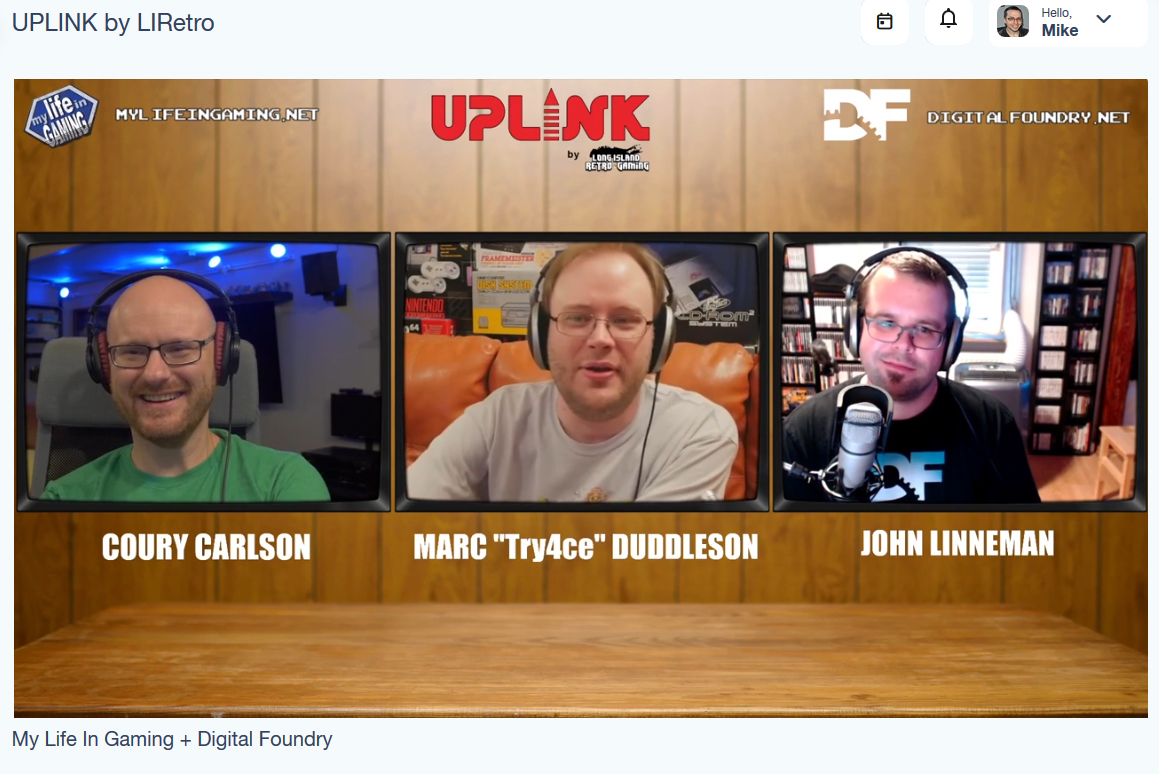


- This was John’s first U.S. convention appearance. He’s an American expatriate based in Germany, and previously France.
- The main topic for the panel was gaming technology.
- October marks seven years since MLiG debuted.
- John joined Digital Foundry in 2013, as well.
- Frame rate graphs
- Video creation process
- Preferring retro games to modern games
- Coury praised John’s wealth of knowledge.
- John said he can look at a game and immediately know how it’ll play.
- John pretends he’s giving an E3 demo when capturing modern games. Try called it a “cinematic approach.”
- Gaming technology originated for Coury with Quake II with its Voodoo graphics accelerator by 3dfx Interactive. He didn’t think much about it again until seeing John’s videos, as did Try.
- SLI (scan-line interleave)
- The evolution of John’s videos
- What started John down the gaming tech path was seeing the Daytona USA arcade game in 1994.
- Try’s entry was F-Zero X on Nintendo 64.
- Try lamented that people will fight over frame rate, saying 60 FPS (frames per second) retro games are impossible. Coury said that’s likely due to early 30 FPS YouTube videos.
- John is a self-taught video editor. Coury and Try come from video editing backgrounds.
- John’s first video in 2015 took a long time to put together
- John and Try exchanged profundities: John’s pearl was “nobody will ever see the video you didn’t make,” while Try recalled his grandfather’s words of wisdom: “good enough never is.”
- The trio went over their video editing techniques.
- Try believes editing more fun when you’re providing each other material. He also used the term “G-roll,” which G to the Next Level liked in the chat.
- John said “it’s more fun to work with a group now, when it’s possible.”
- What’s the toughest part about making a video? For Coury, it’s writing. Try is better at that, saying he enjoys it, though he said he gets wordy at times. Coury leans more into editing, which is toughest for Try. The toughest part for John is stress. He feels a sense of accomplishment after finishing a video’s introduction. Then, the writing becomes easier. He writes in chunks.
- Coury has been experimenting with writing outlines, taking bullet points (like the ones in this post) and turning them into paragraphs.
- John uses Notepad.
- Try writes notes so he doesn’t forget.
- John on editing: “What could look cool here?”
- Try: Slider shots
- Coury: Comparison shots
- Coury cautioned that “you don’t want to repeat shot ideas from episode to episode.”
- John is proud of the intro to his Analogue Super Nt video.
- Try is proud of the Play It Loud intro to the MLiG Super Nt video, with its low frame rate, Play It Loud music, and Kevtris soundbites.
- Coury: Hands-on feel
- They spoke of the Analog Frontiers series (part 1, part 2).
- Try’s dog Sandy made a couple of cameos in the panel.
- John’s PC gameplay capture was used by Try in a video via PC monitor.
- Why does John say “Mega Drive” instead of “Genesis“? He loves the name, and has more Japanese Mega Drive games than Genesis games.
- Try believes the PC Engine scene is bigger than TurboGrafx-16 scene. That means there’s more interest in the PC Engine than for its North American counterpart, which released two years after Japan.
- What were their first experiences seeing RGB on a PVM? John’s came circa 2004. Coury’s first experience was seeing Dreamcast in composite on a CRT. For Try, it was S-Video in college in 2002 and then RGB explanations on Hazard-City.
- Voiceover techniques
- Capture techniques
- Storyboarding and animation
- John: “I just envision it in my head.”
- Coury suggests that if you get stuck, step away and try again the next day.
- Two of Try’s creative locations are in the shower and on the toilet.
- John is most proud of the video he did on the making of Onrush. He filmed it all in a day and edited over three days. It’s not the best, but he’s proud nonetheless. It didn’t get many views because the game didn’t get much attention.
- What are your dream documentary subjects? Coury’s is Working Designs. Try would like to profile the original Final Fantasy staff, including creator Hironobu Sakaguchi. John’s dream subject is the original creators of the Sega Saturn. He’d like to understand the entire process, from initial thought to release, and its legacy.
- What’s the most powerful mini console? John said the Capcom Home Arcade. For hacking purposes, Try went with the PlayStation Classic. Coury’s choice was the Super NES Classic Edition.
- What videos would they like to do over or differently? Try would like to redo most older videos. The voiceover has improved so much over the years. He would redo the Myst series video. He wouldn’t have written his opinions into the script or use first- or second-person terms.
- Has John gotten pushback from a company? Once. Most are happy. On his Redout video, he made a small error regarding the Xbox One X version. He received threats. (A retest video followed.)
- John tries to be positive and documentary-like in videos, helping people understand things. He’s not a raging critic, referring to “angry videos,” though he can’t fault them.
- They all prefer the OSSC to the Framemeister.
- They think of Bob Neal when referring to bob deinterlacing.
- There was a question in the chat about Analog Frontiers with Saturday’s information reiterated. New to this panel was Try considering a spinoff called Analog Frontiers Gaiden. John offered to do a Gaiden video about The CRT Wizard in Germany (referenced in this tweet). Try also noted Artemio Urbina and Tim Worthington will appear briefly in part 5. (Artemio previously appeared in part 2.)
- They all prefer open world over simulation in contemporary games.
- Try believes the generic AAA game formula has become tiresome.
- What’s your favorite modern game? John was torn between Sonic Mania and Monster Boy and the Cursed Kingdom. Coury’s favorite is also Monster Boy. Try’s is The Legend of Zelda: Breath of the Wild for Nintendo Switch.
- Thanks to everybody who hung out and watched.
- John said it was good to see G To the Next Level in the chat. He feels like he’s competing with him on Genesis videos. (Here’s one such video.)
- Thanks to John for staying up late, as it was 10PM local time.
The panel ran 45 minutes over its intended 3:15 end time. Like the Saturday panel, this one is available to watch on the MLiG YouTube channel:
I don’t think I’ve ever taken this many notes for a blog post. It was a worthwhile endeavor to archive the discussions I witnessed. I hope to be back at the Cradle of Aviation Museum next August to take many photos of panels and exhibits, meet and greet the panelists, and pickup retro games from vendors. Stay safe and healthy, and thank you for reading.
Instrumental Invasion, 8/19/20 August 20, 2020
Posted by Mike C. in Airchecks, Audio, History, Internet, Jazz, Media, Music, Personal, Travel, TV, Video, Video Games.add a comment

The August 19, 2020, Instrumental Invasion on WCWP was recorded on July 24 (hour 1) and 25 (hour 2).
The playlist was created, modified, and annotated between July 21 and 23.
To accommodate my chatty second talk break of hour 1’s second segment, I had to replace the Jeff Lorber Fusion song I had in mind. Instead of “Bright Sky” off Galaxian, I went with “Lava Lands” from Wizard Island. It was a fitting choice, having watched the Oregon episode of Smithsonian Channel’s Aerial America on their YouTube channel a few days before recording. The Fusion’s album is a reference to various landmarks in Oregon, including Lava Lands Visitor Center and, of course, Wizard Island, which is located within Crater Lake.
I had to rerecord the second and third talk breaks of the above segment on the morning of the 25th, shortly after waking up. That’s why my voice sounded the way it did. I realized that morning I’d mistakenly left out Will Lee on bass while talking about “Some Down Time” by Steve Khan, and wanted to correct that immediately. I had to script the talk breaks so I wouldn’t get flustered or forget what to say.
As I did in my 2018 and ’19 Homecoming Weekend shows, I dedicated the Keiko Matsui song I played – in this case, “Marlin Club Blues” – to Game Dave, citing a video where he suggested you listen to her music rather than in-game music:
I neglected to mention that Randy Waldman played keyboards and Hammond B-3 organ on “Marlin Club Blues.” Keiko was only on piano.
And speaking of YouTube, here is the music video for “Living Out Loud” by Joyce Cooling that I recommended:
Click here to download the aircheck MP3 or listen below:
8/22 UPDATE: While watching the Houston portion of The 8-Bit Guy‘s second Tech from Texas video, it occurred to me that David Benoit‘s song “El Camino Real” was not about the road in California, but the trail in Texas. It should have been obvious since a song called “Houston” precedes it on his Inner Motion album. As a California native, I assumed David had the California road in mind when I annotated the playlist. Clearly, I was wrong.
Instrumental Invasion, 8/12/20 August 13, 2020
Posted by Mike C. in Airchecks, Audio, Education, Jazz, Media, Music, Personal, Radio.add a comment

The August 12, 2020, Instrumental Invasion on WCWP was recorded on July 17.
The playlist was created on July 15 with annotations later that day and the day after.
I liked sharing the origin of an infamous hip-hop breakbeat sample by playing Bob James‘s cover of “Take Me to the Mardi Gras” by Paul Simon. Coming out of that song, a new liner debuted from Joe Bertie, co-host of WCWP’s The Smooth Jazz Show:
Joe got in touch with me hours before air so he’d know when it would run. He recorded the moment and posted it to Facebook with the caption:
Voiceover liner for “Instrumental Invasion” with Mike Chimeri. Terrific show.
I dedicated Jeff Golub and Brian Auger’s rendition of “The Cat” to Bobby Guthenberg, a.k.a. Bobby G., one of the hosts of The Rock Show, which airs weeknights at 7PM and Sundays at 10PM.
The extra time before “Old School” by Nelson Rangell allowed me to reference LIU Post‘s founding in 1954, and the years in which I was a student.
Extra time was limited in most segments, which meant starting songs underneath liners or fading them under early so I could back-sell.
The disparity between audio channels on “Cantiga Nova Swing” by the Dave Brubeck Quartet was so wide, I had to combine them into mono.
Click here to download the aircheck MP3 or listen below:
Instrumental Invasion, 8/5/20 August 8, 2020
Posted by Mike C. in Airchecks, Audio, Internet, Jazz, Media, Music, Personal, Radio.add a comment
 The August 5, 2020, Instrumental Invasion on WCWP was recorded over three days in July.
The first segment was recorded on the 10th, the next four on the 11th, and the last two on the 12th.
The playlist was created on July 6 and annotated on the 7th with additional annotations during the recording sessions.
There was a lot of ADR (automated dialogue replacement) in the various segments, but I still forgot to acknowledge David Benoit when I was naming Rippingtons alumni in the last bit of ADR. By the time he came to me, a day had passed since submitting the show for air.
Two hours before air, my cable went out and stayed out until around 2:30 on Saturday afternoon. This means I was unable to aircheck my show as it aired on WCWP. I had to make one out of my segment files, applying the broadcast multiband compression filter in Adobe Audition.
Click here to download the “aircheck” MP3 or listen below:
The August 5, 2020, Instrumental Invasion on WCWP was recorded over three days in July.
The first segment was recorded on the 10th, the next four on the 11th, and the last two on the 12th.
The playlist was created on July 6 and annotated on the 7th with additional annotations during the recording sessions.
There was a lot of ADR (automated dialogue replacement) in the various segments, but I still forgot to acknowledge David Benoit when I was naming Rippingtons alumni in the last bit of ADR. By the time he came to me, a day had passed since submitting the show for air.
Two hours before air, my cable went out and stayed out until around 2:30 on Saturday afternoon. This means I was unable to aircheck my show as it aired on WCWP. I had to make one out of my segment files, applying the broadcast multiband compression filter in Adobe Audition.
Click here to download the “aircheck” MP3 or listen below:
Instrumental Invasion, 7/29/20 July 30, 2020
Posted by Mike C. in Airchecks, Audio, Drama, Internet, Jazz, Media, Music, Personal, Radio, TV.add a comment

The July 29, 2020, Instrumental Invasion on WCWP was recorded on the 9th.
The playlist was created on July 3 and annotated on the 4th with additional annotations while recording.
Click here to download this week’s aircheck MP3 or listen below:
 MikeChimeri.com